THE AMERICAN WEST (mostly): Fact and Fiction (mostly fiction)


"NOBODY GETS TO BE A COWBOY FOREVER." -- Chet Rollins (Jack Palance) in MONTE WALSH (NG, 1970)

Total Pageviews

Thursday, January 2, 2014

AMERICAN RUST by Philipp Meyer

In American Rust, Philipp Meyer’s debut novel, the steel mill in the fictional town of Buell, Pennsylvania closed in 1987 and was partially dismantled ten years later. Now the mill stands like an ancient ruin that is being taken over by vines and other vegetation. The only visitors are coyotes and deer and an occasional human squatter. Buell was “a place that had recently been well-off, its downtown full of historic stone buildings, mostly boarded now.” What is true of Buell is also true of other steel mill towns located in the Mon Valley.

For a hundred years the Valley had been the center of steel production in the country, in the entire world, technically,” but globalization and automation, along with outsourcing and offshoring, have taken its toll and in the last two decades the area has lost 150,000 jobs and “most of the towns could no longer afford basic services; many no longer had any police.”

One character, a former police chief and current justice of the peace, says that “it wasn’t just that we lost all those jobs, it was because people didn’t have anything to be good at anymore….We’re trending backwards as a nation, probably for the first time in our history, and it’s not the kids with the green hair and the bones through their noses. Personally I don’t care for it, but those things are inevitable. The real problem is the average citizen does not have a job he can be good at. You lose that, you lose the country.”

Now the Valley is primarily the home of retirees who have no choice but to stay and the young who haven’t acquired the courage to leave. Two of the young people are odd-couple friends, Isaac English and Billy Poe.

Isaac English and his older sister were the two smartest kids in town, the whole Valley, probably; the sister had gone to Yale. A rising tide, Isaac had hoped, that might lift him as well.” But at age twenty, and two years out of high school, and despite an IQ of 167, Isaac still lives in Buell. He is one who wants to leave but remains to care for his father, who is an invalid as the result of a steel mill accident.

The whole town thought Billy would go to college to keep playing [foot]ball…[but] two years later here he was living in his mother’s trailer,” a double-wide that “sat at the top of a dirt road…on a large tract of woodland.” Billy turned down a scholarship to Colgate because, unlike Isaac, he can’t understand why anyone would ever want to leave Buell. He thinks this despite the fact that he is unemployed after recently being laid-off from a minimum wage job.

The world spins out of control for the two friends when, in the early stages of Isaac’s attempt to finally breakaway and head West to attend college, he and Billy become involved in a killing (Is it murder or self-defense?). The tragic event and its repercussions overwhelm the two young men and devastate them and their families.

Philipp Meyer’s second novel, The Son, which has received almost universal acclaim from critics, is on most of the “best books of the year” lists that are now being published. The critics also liked American Rust, but readers have been decidedly mixed in their reaction to it. A lot of them like it and a lot of them hate it.

Here are three primary complaints about the book: 1) there are six alternating narrators; 2) they engage in stream-of-consciousness thought and; 3) there is an open-ended conclusion that leaves many of the novel’s conflicts unresolved and its questions unanswered.

I thought Meyer was able to juggle his narrators effectively, so I didn’t find that to be a distraction. I can’t speak for others, but I rarely think in paragraphs, or even complete sentences. In fact, there isn’t a lot of punctuation in my thoughts. Therefore, I thought his usage of stream-of-consciousness helped me better understand his characters and their motivations. And let’s face it, if life is anything, it is open-ended and many conflicts do remain unresolved and many questions are never answered.

American Rust is a social protest novel that harkens back to the ‘30’s and writers such as John Steinbeck and others who championed working people and protested the economic dislocation of the day. Meyer's depiction of the economic decline that has devastated the Pennsylvania steel industry reminds me of what Richard Russo has written about similar decline in his area of upstate New York. And if one took Meyer’s characters and placed them in Mississippi, they would be very similar to characters created by the late Larry Brown.

Critics have compared Meyer to Cormac McCarthy, Ernest Hemingway, and Dennis LeHane. I even saw a headline which asked “Is Philipp Meyer the next William Faulkner?” And that was before The Son. But the answer is no, of course not, there will only be one Faulkner. But that’s certainly high praise for a debut novel and could have been the kiss of death. However, Meyer did not fall prey to the sophomore jinx. The Son has been even better received than American Rust. And I look forward to reading it.


TRUE GRIT (Paramount, 2010)

DIRECTORS: Joel & Ethan Coen;  PRODUCERS: Joel & Ethan Coen, Scott Rudin;  WRITERS: screenplay by Joel & Ethan Coen based on Charles Portis novel of same title;  CINEMATOGRAPHER: Roger Deakins

CAST: Jeff Bridges, Matt Damon, Josh Brolin, Hailee Stanfeld, Barry Pepper, Dakin Matthews, Paul Rae, Domhnall Gleeson, Elizabeth Marvel, Roy Lee Jones, Ed Corbin, Leon Russom, Bruce Green


(Rather than rehashing the film’s plot, which does adhere closely to the novel, allow me to direct you to my review of the novel, which you can read here.  I also reviewed the original film and if you wish, you can read it here.)

An off-screen Mattie Ross, now a 40-year-old spinster, sets the stage for what is to come: 

"People do not give it credence that a fourteen-year-old girl could leave home and go off in the wintertime to avenge her father’s blood but it did not seem so strange then, although I will say it did not happen every day.  I was just fourteen years of age when a coward going by the name of Tom Chaney shot my father down in Fort Smith, Arkansas, and robbed him of his life and his horse and $150 in cash money plus two California gold pieces that he carried in his trouser band."

This passage also opens Charles Portis' novel.  It is significant that the Coens opened the film in this manner.  They are on record as saying that they did not intend to film a remake of the 1969 original.  Instead, they indicated that their goal was to film the book.  Their plans are further re-enforced by the fact that Marguerite Roberts, who wrote the screenplay for the original, received no mention in their version’s credits.

I’m not sure why the Coens shied away from the original screenplay, since it was skillfully written by Roberts.  It followed its original source much more closely than most screenplays do.  And because it does, the Coens in their efforts to, as they said, film the book means that the films share many common characteristics.

Okay, so it isn't an official remake.  Nevertheless, both films feature the same characters, much of the same dialogue, and many of the same scenes.  That sounds like a remake, doesn't it?  So, let's call it an unofficial remake and let it go at that.


"I'm a foolish old man who's been drawn into a wild goose chase by a harpie in trousers and a nincompoop."

The films do differ in some respects, of course, or else why bother with producing a second one.  For one thing, the original was a John Wayne vehicle.  Never for one moment does the viewer forget that he is the star of the film.

The remake (well, it is) is not a star vehicle.  It is more of an ensemble effort that is made possible because it does not star a legend and the fact that better actors are cast in the two most important supporting roles.  Matt Damon, as one would expect, is a big improvement over singer Glen Campbell in the role of Texas Ranger LeBoeuf.  And not only is 13-year-old Hailee Standfeld, as Mattie Ross, an improvement over 21-year-old Kim Darby, the character's part has been elevated to a position more in keeping with the novel.

 
the "harpie in trousers" and the "nincompoop"

Both Wayne and Jeff Bridges are very good in the role of U.S. marshal Rooster Cogburn.  But they are different Roosters.  Bridges plays it just as mean and ornery as Wayne, but he is more subdued and doesn't dominate scenes the way Wayne did in the original.  Partly that has to do with the different approaches of the two actors and partly because Bridges had better support in the two pivotal supporting roles.

The remake is an improvement in a couple of other ways as well.  The 1969 film was beautifully photographed by Lucien Ballard.  However, the snow-capped peaks and quaking aspens of the Colorado Rockies was not a good stand-in for Oklahoma.  For anyone familiar with the geography of eastern Oklahoma all that majestic scenery can be disconcerting.  I was disconcerted.  I don’t know why the Coens didn’t use Oklahoma locations, but at least the ones they chose in Texas and New Mexico look much more authentic than those featured in the original film did.

The other improvement concerns the ending of the film.  For the most part, Roberts stuck fairly close to the novel when she wrote the screenplay for the original film, but she did deviate when it came to the film’s conclusion.  It probably wasn’t her idea, but that of the producers who wanted John Wayne to ride off into the sunset in a manner in keeping with his legendary status.

The Coens stayed with the book and the way they staged it is perfect.  The beginning and the ending are bookends that serve to emphasize their great admiration for Portis’ classic novel.

I like both films.  The 1969 film, even with some of its drawbacks, is still very enjoyable.  The Coens, to their credit, have improved upon what was already a very good film.  That doesn’t always happen with remakes (see 3:10 to Yuma, for example) I hope they revisit the Western genre soon.


REVIEWS

TRUE GRIT seems to be an honest stab at transferring a beloved book as accurately as possible from page to screen." – Richard Corliss in Time

“Steinfeld is the heart, star and glory of TRUE GRIT.” – Richard Corliss in Time

“… justice comes swiftly but fairly, and no one ends up dead who didn’t have it coming.  It is, at bottom, an emotional, even ardent, film. – David Carr in The New York Times

“Nothing very startling happens, but the Coens have a sure hand, and Bridges, in the old John Wayne role, plays a man, not a myth; you can sense Rooster’s stink and his nasty intelligence, too.” – David Denby in The New York Times

“Roger Deakins … tops himself here, fashioning scenes that have weight and resonance.” – Leonard Maltin

“But the real reason to see this film is the work of the Coens’ regular collaborators, cinematographer Roger Deakins and composer Carter Burwell, who supply the visual and auditory landscapes that are TRUE GRIT’s most notable achievement.” – Christopher Orr in The Atlantic


Tuesday, December 17, 2013

TRUE GRIT (Paramount, 1969)


Judge Parker's courthouse as it looks today

DIRECTOR: Henry Hathaway;  PRODUCER: Hal B. Wallis;  WRITERS: screenplay by Marguerite Roberts based on Charles Portis novel of same title; CINEMATOGRAPHY: Lucien Ballard

CAST: John Wayne, Glen Campbell, Kim Darby, Jeremy Slate, Robert Duvall, Dennis Hopper, Alfred Ryder, Strother Martin, Jeff Corey, Ron Soble, John Fiedler, James Westerfield, John Doucette, Donald Woods, Edith Atwater, John Pickard, Myron Healey, H.W. Gim, Boyd Morgan, Stuart Randall, Guy Wilkerson, Hank Worden


THE PLOT.
You probably already know the plot, don’t you?  Well, just in case you don’t, here is how the story begins.

Fourteen-year-old Mattie Ross (Kim Darby), from near Dardanelle, Arkansas in Yell County, travels to Fort Smith to settle her dead father’s affairs.  Her father was murdered in that town by a man who worked for him, a man who called himself Tom Chaney (Jeff Corey).  After killing her father, Chaney robbed him of his horse and his money.  Apparently, the fugitive has fled to the Indian Territory (present-day Oklahoma) and there are reports that he has joined up with the “Lucky” Ned Pepper (Robert Duvall) gang.
 
21-year-old Kim Darby as 14-year-old Mattie Ross
Mattie is not content to just settle her father’s affairs (outwitting a horse trader portrayed by Strother Martin in some delightful scenes), but also plans to go after Chaney and bring him back to Fort Smith for trial.  The federal judge in Fort Smith is Judge Isaac Parker (James Westerfield) and his court for the Western District of Arkansas has jurisdiction over not only western Arkansas, but also the Indian Territory in any case involving a white person.
 
Since Mattie knows she can’t travel alone into that treacherous territory and achieve her goal of capturing Chaney and since the territory comes under federal jurisdiction, she decides to recruit a U.S. deputy marshal to assist her, one who possesses “true grit.”


MATTIE (Kim Darby): “Who’s the best marshal they have?”

SHERIFF (John Doucette): “Bill Waters is the best tracker.  The meanest one is Rooster Cogburn, a pitliless man, double tough, fear don’t enter into his thinking.  I’d have to say L.T. Quinn is the straightest, he brings prisoners in alive.”

MATTIE: “Where would I find this Rooster?”


After Mattie meets Reuben J. “Rooster” Cogburn (John Wayne), she isn’t sure that he is the kind of man that she is seeking, a man who has “true grit,” a quality that she recognizes because she personally possesses it in full measure.  He is a one-eyed, hard-drinking, ruthless, overweight man who for his part isn’t sure that he wants to work for any woman, especially Mattie.  However, greed overcomes his reluctance when Mattie offers to pay him a hundred dollars, his asking price for the job.  It is more than Mattie wants to pay, but she is able to force a compromise by paying him fifty now and promising the other fifty after the mission is accomplished.


Who knew aspens grew in Oklahoma?
Matters become even more complicated when a Texas Ranger (Glen Campbell) by the name of LaBouef (pronounced La-Beef) arrives in Fort Smith.  He is also on Chaney’s trail.  It seems that Chaney killed a state senator in Texas and that state and the senator’s family have placed a bounty on the fugitive’s head. The marshal and the ranger, although they have taken a strong disliking to each other, decide to join forces and split the proceeds  -- assuming they are able to capture – or kill – Chaney.

Neither of the lawmen wants a fourteen-year-old girl to tag along and they attempt to leave her behind, but they don’t know Mattie.  She will not be denied.  The three, at odds with each other and with differing goals, ride into the territory in search of Tom Chaney.


THE STARS.
The role of Rooster Cogburn, as everyone knows, is the role for which John Wayne finally won a long overdue Best Actor Oscar.  His only other nomination had occurred exactly twenty years earlier when he was nominated for his role as Sgt. Stryker in SANDS OF IWO JIMA (Republic, 1949).  He could have been nominated, but wasn’t, for his roles as Tom Dunson or Nathan Brittles or Tom Doniphon.  The biggest oversight, however, came when he was overlooked for what was his greatest performance, that of Ethan Edwards in THE SEARCHERS (WB, 1956).  Even harder to explain is the fact that the film did not receive a single nomination for anything.


ROOSTER COGBURN (John Wayne): “Boots, I got Hayes and some youngster outside with Moon and Qunicy. I want you to bury ‘em for me. I’m in a hurry.”
 
CAPTAIN BOOTS FINCH (Ron Soble): “They’re dead?”

ROOSTER COGBURN: “Well, I wouldn’t want you to bury ‘em if they wasn’t.”


Variety praised Wayne’s performance: “…it’s mostly Wayne all the way.  He towers over everything in the film….He rides tall in the saddle in this character role of ‘the fat old man.’”

Roger Ebert wrote: “Hathaway…has made the movie of his lifetime and given us a masterpiece….Wayne towers over this special movie.”

Wayne’s performance as Rooster Cogburn was not his greatest, but it was very good.  There is, however, some irony in the fact that he won the award for what in effect is a self-parody.  It is generally conceded that he didn’t win for that film anyway, that he was rewarded for his body of work.  If so, it isn’t the only time that such a thing has occurred.  And there is little doubt that TRUE GRIT represented his last chance for a bite of the academy apple – with one exception, albeit a slim one.  He might have been considered for his role as J.B. Books in his very last film, THE SHOOTIST (Paramount, 1976), had he not won earlier.  But maybe not, since he did not receive a nomination for that role.

Glen Campbell, originally from near Delight, Arkansas, made his film debut in TRUE GRIT.  When I first viewed the film right after it was released, I couldn’t help but think how much better it would have been if a more talented actor had been chosen to play LaBeouf, the Texas Ranger.  I still felt that way each time I watched it over the years.  But I also felt that it wasn’t fair to Campbell, a hugely talented singer and musician (later inducted into the Country Music Hall of Fame), that he was put in such a position, forced to try to hold his own with so many seasoned professionals.  The director, Henry Hathaway, had not wanted him and reportedly gave the novice actor a hard time.  That led to some conflict during the production because Duvall objected strenuously to Hathaway’s badgering of Campbell, which led Wayne to take Hathaway’s side.  Wayne probably remembered how as a young actor he had been tormented by John Ford and may have thought that it was how veteran directors had to operate in order to elicit good performances from young actors.


Glen Campbell, Texas Ranger

Campbell had no illusions about his acting.  He once said, “I’d never acted in a movie before, and every time I see TRUE GRIT I think my record is still clean.”  But when I watched the film recently, I reconsidered his performance.  It wasn’t exactly great, but it wasn’t that bad either.  I now think that had he continued to work at it he could have become a competent actor. 

The following year he starred in one last film.  It was NORWOOD (Paramount, 1970).  Like TRUE GRIT, it was based on an excellent Charles Portis novel with a screenplay written by Marguerite Roberts, was produced by Hal Wallis, and co-starred Kim Darby.  Instead of John Wayne, however, the third lead role went to football star Joe Namath. 

The film was not a success and though Campbell would later make a few cameo film appearances, he chose to concentrate on his music.

Kim Darby had appeared in three feature films prior to TRUE GRIT, but the film’s success and popularity didn’t do much to advance her career either.  Like Campbell, she gave a good performance, but the role of Mattie Ross called for a stronger – and younger – actress.  If it is true that Darby didn’t look as old as her age at the time, twenty-one, it is also true that she looked much older than Mattie’s fourteen.

Wayne was also older than his character was in the book.  He was 61 at the time while his character in the book was about forty.  It didn’t really matter, but I’m certain there were no deputy marshals that age hunting down desperadoes in the Indian Territory.

 Added to the other conflicts already mentioned, it seems that Wayne had no liking for Darby.  He had wanted another actress to be cast in the role and was extremely critical of Darby’s acting.  He was also critical of her work ethic, later stating that he found her to be unprofessional.  But if so, it is impossible to detect any evidence of conflict between the two on the screen.

After starring with Campbell in NORWOOD, Darby was thereafter mostly limited to acting in TV productions.


THE SUPPORTING CAST.
Robert Duvall began his acting career on the stage in the late ‘50’s and then became an extremely busy TV actor in the 60’s.  He made his feature film debut in 1962 in a small but effective role as Boo Radley in TO KILL A MOCKINGBIRD (UI, 1962).  Afterwards he returned to TV and the stage for most of the rest of the decade.  Then in the late ‘60’s he began to appear in a number of feature films.  He had appeared in a ton of TV Westerns but his role as “Lucky” Ned Pepper served as his first in a Western feature film.

The following year he gained good notices as Frank Burns in M*A*S*H (Fox, 1970).  But it was because of his role as Tom Hagen in THE GODFATHER (Paramount, 1972) that his career really took off.  For his performance, he received an Academy Award nomination for Best Supporting Actor.  That was only the beginning.  He has since been nominated on five other occasions and has won one award.  He received the Best Actor Oscar for his performance in TENDER MERCIES (EMI, 1983).  He is one who pulled off the rare feat of graduating from the ranks of supporting players to become a star.

He gave a strong performance in TRUE GRIT and he appeared in several other Western films, but his greatest performance in a Western was as Gus MaCrae in the TV mini-series LONESOME DOVE (Motown, 1989).  Perhaps I’m prejudiced, but I think it was, at least to this point, his greatest performance ever.


Gus McCrae and Woodrow Call

The film includes a number of familiar and welcome faces, actors such as Strother Martin (such a good actor), Jeff Corey, Dennis Hopper, Jeremy Slate, Hank Worden, Stuart Randall (his final film), John Doucette, Guy Wilkerson, and John Fiedler (as the lawyer J. Noble Dagget).  It was also nice to see Myron Healey, who played badmen in a countless number of TV and movie Westerns, get to portray a lawman for a change.


THE DIRECTOR.
Henry Hathaway, seventy-one-years-old, had been directing films since 1932. His first was a Zane Grey story, HERITAGE OF THE DESERT (Paramount).  The director’s next seven films were also Westerns based on Zane Grey stories.  Randolph Scott, in his first starring roles, starred in six of the eight.  All had been filmed as silent films and Hathaway’s films relied extensively on stock footage from the silent productions.  They were all entertaining and well-made B+ programmers that were enjoyed by Western movie fans.

In a directing career that lasted four decades, he directed sixty-five films, including twenty Westerns.  

His first film with John Wayne had been THE SHEPHERD OF THE HILLS (Paramount, 1941), followed by NORTH TO ALASKA (Fox, 1960), CIRCUS WORLD (Paramount, 1964), THE SONS OF KATIE ELDER (Paramount, 1965) and TRUE GRIT.


The Director

THE WRITERS.
Screenwriter Marguerite Roberts and her husband, also a writer, were blacklisted during the ‘50’s communist witch-hunt days.  As a result, beginning in the early years of that decade and extending into the early ‘60’s, there is a ten-year gap in her filmography.  What makes this ironic is the fact that John Wayne, who never made a secret of his right wing political views or his support of the blacklist, found himself starring in a film whose screenwriter had been victimized by that same blacklist.  Roberts wasn’t the only individual associated with the film to have experienced such a fate during that era.  Jeff Corey, who portrayed Tom Chaney, had also been blacklisted.  Surely, Wayne was aware of the blacklisting of Roberts and Corey, but if so, he never referred to it and evidently, it was never the source of any conflict during the production.

Roberts did not depart much from Charles Portis’ novel in her adaptation.  Her major change was in the ending.  As one critic noted, the ending was changed in order to allow John Wayne to ride into the sunset.

Earlier I reviewed Portis’ novel and you can read that review here.


CINEMATOGRAPHY AND LOCATION.
Lucien Ballard’s career as a cinematographer extended all the way back to the mid-30s, when he began working on what were primarily B-movies, including some of the Charles Starrett Westerns at Columbia.  In the ‘50’s, he began to work on more prestigious films

Among his Western credits are RIDE THE HIGH COUNTRY (MGM, 1962), THE SONS OF KATIE ELDER (Paramount, 1965, starring John Wayne and directed by Henry Hathaway), WILL PENNY (Paramount, 1968), THE WILD BUNCH (WB, 1969), as well as Audie Murphy’s final film, A TIME FOR DYING (1969).

Ballard was a native of Oklahoma and must have been amused by the locations that were chosen for TRUE GRIT.  It is true that there are hills in eastern Oklahoma, but no snow-capped peaks!  Nevertheless, there they are in the film – along with golden aspens shimmering in the breeze, which are also not found in Oklahoma.  It is true that the Colorado locations that were filmed are much more spectacular than anything found in Oklahoma and that Ballard’s expert photography made beautiful use of them, but it is disconcerting for any viewer who has any knowledge of the geography of the area in which the story is set.

But if it is true that nobody should go to a movie to learn history, then I guess it would be fair to say the same thing about geography.


ROOSTER COGBURN.

In addition to TRUE GRIT (1969), the Rooster Cogburn character has been the subject of two feature films and one TV movie. 

Two other feature films:

ROOSTER COGBURN (Universal, 1975)

DIRECTOR: Stuart Miller;  PRODUCER: Hal B. Wallis;  WRITERS: screenplay by Martha Hyer (as Martin Julien) suggested by Charles Portis novel, True Grit; Cinematographer: Harry Stradling, Jr.

STARRING: John Wayne, Katharine Hepburn


TRUE GRIT (Paramount 2010)

DIRECTORS: Joel and Ethan Coen;  PRODUCERS:  Joel and Ethan Coen;  WRITERS: screenplay by Joel and Ethan Coen based on Charles Portis novel of same title;  CINEMATOGRAPHY: Roger Deakins

STARRING: Jeff Bridges, Matt Damon, Hailee Stanfield


You can read my review of this film here.


TV movie (filmed as pilot for possible series that never developed):

TRUE GRIT (Paramount TV, 1978)

DIRECTOR: Richard T. Heffron;  PRODUCER: Sandor Stern;  WRITERS: screenplay by Sandor Stern based on characters created by Charles Portis in novel of same title;  CINEMATOGRAPHY: Stevan Larner

STARRING: Warren Oates, Lisa Pelikan 


 LUCKY” NED PEPPER (Robert Duvall):  “What’s your intention?  Do you think one on four is a dogfall?”

ROOSTER COGBURN (John Wayne):  I mean to kill you in one minute, Ned.  Or see you hanged in Fort Smith at Judge Parker’s convenience.  Which’ll it be?”

NED PEPPER: “I call that bold talk for a one-eyed fat man.”

ROOSTER COGBURN: “Fill your hands, you sonvabitch!”


Saturday, December 7, 2013

TRUE GRIT by Charles Portis


"People do not give it credence that a fourteen-year-old girl could leave home and go off in the wintertime to avenge her father’s blood but it did not seem so strange then, although I will say it did not happen every day.  I was just fourteen years of age when a coward going by the name of Tom Chaney shot my father down in Fort Smith, Arkansas, and robbed him of his life and his horse and $150 in cash money plus two California gold pieces that he carried in his trouser band."

So begins Charles Portis’ 1968 novel, True Grit.  Mattie Ross, now a forty-year-old spinster, narrates the events that surrounded her quest to find and punish her father’s killer.  The opening passage demonstrates the deadpan quality of her narration as well as the detail in which she recounts her single-minded determination to achieve her goal no matter the obstacles that she will have to fight to overcome.

Chaney, after killing her father, fled to the Indian Territory (present-day Oklahoma) and joined up with the “Lucky” Ned Pepper gang.  Mattie realizes that she can’t travel alone into that treacherous territory and achieve her goal of bringing Chaney back to Fort Smith to stand trial in Judge Isaac Parker’s federal court for the Western District of Arkansas.  That court also has jurisdiction over any case in the territory that involves a white person who is either a victim or perpetrator.  Therefore, because the territory comes under federal jurisdiction, she sets out to hire the district’s meanest, toughest, orneriest U.S. deputy marshal to assist her.

She seeks advice on this matter from the local sheriff:

Who is the best marshal they have?”

The sheriff thought on it for a minute.  He said, ‘I would have to weigh that proposition.  There is near about two hundred of them.  I reckon William Waters is the best tracker.  He is a half-breed Comanche and it is something to see, watching him cast for sign.  The meanest one is Rooster Cogburn.  He is a pitiless man, double-tough, and fear don’t enter into his thinking.  He loves to pull a cork.  Now L.T. Quinn, he brings prisoners in alive.  He may let one get by now and then but he believes even the worst of men is entitled to a fair shake.  Also the court does not pay any fees for dead men.  Quinn is a good peace officer and a lay preacher to boot.  He will not plant evidence or abuse a prisoner.  He is straight as a string.  Yes, I will say Quinn is about the best they have.’”

I said, ‘Where can I find this Rooster?’”

Mattie isn’t looking for a good tracker, or a fair man, she is looking for a man with “true grit,” a characteristic that she admires and that which she personally possesses in full measure.  It turns out that Reuben J. “Rooster” Cogburn is a one-eyed, hard-drinking, ruthless, fat man of about forty who isn’t sure that he wants to work for Mattie, or, as he makes plain, any woman.  But after much verbal sparring between the two, Rooster’s reticence is overcome by Mattie’s agreement to pay him the hundred dollars he demands for taking on the job.  It is more than she wants to pay, but she compromises by promising to pay him fifty now and the other fifty after the mission is accomplished.

Matters become even more complicated when a Texas Ranger by the name of LaBoeuf (pronounced La-Beef) arrives in Fort Smith.  He is also on Chaney’s trail.  It seems that Chaney killed a state senator in Texas and that there is a sizable bounty on his head.  The marshal and the ranger decide to join forces and split the proceeds if they are able to capture – or kill – the fugitive.

Anyhow, it sounds queer.  Five hundred dollars is mighty little for a man that killed a senator.”

Bibbs was a little senator,” said LaBoeuf.  “They would not have put up anything except it would look bad.” 

Neither of the lawmen wants a fourteen-year-old girl to tag along and they attempt to leave her behind, but they don’t know Mattie.  She will not be denied.  The three, at odds with each other, and with differing goals, ride into the territory in search of Tom Chaney.

Even if you have watched one or both of the movies based on the book, both of which are good adaptations, the book is still an enjoyable read.  It is unfortunate that the two successful movies have had the effect of shoving the book below the reading public’s radar screen.  However, the publisher did re-issue the book as a tie-in with the recent movie and therefore it is back in print and is no longer hard to locate.

Novelist Donna Tartt, writing in the introduction to the new edition, calls the book a masterpiece.  She writes that four generations of her family, beginning with her great grandmother, deeply admired the novel.  Her great grandmother was in her eighties when she first read it and introduced it to the other females in the family: her middle-aged grandmother; her twenty-something mother; and to her, who was ten when she first read it. 

She does not mention any male members of her family being enamored with the book, and it is easy to see how this independent, bold, courageous, and yes, self-righteous and unaware young heroine would resonate with her and her female relatives.  Mattie is the star of the story, but she is ably assisted by Rooster and LaBeouf and there are enough thrills and adventures to appeal to readers regardless of gender or age.

One of the book’s many qualities is that it can be read on more than one level.  It can be approached as a coming-of-age story, or an adventure story, or a satire, or a story of redemption and loss of innocence, for it contains all these elements.  As Michael Cleary wrote in Twentieth Century Western Writers, “True Grit is … a curious amalgam of parody, formula, and myth.”  Cleary points out that Rooster, motivated by greed rather than justice, violates almost all perceptions of a Western hero.  “Portis overlays realism on the romantic world of the West.  [Therefore,] Rooster is not burdened by the moral introspection of a Virginian or Shane.”  Yet, in the end, his actions do rise to heroic proportions.

But Rooster meets his match when he tries to get the best of Mattie Ross.  Here we have two people who are willing to do whatever is necessary to achieve their goals.  But more times than not, it is Mattie who prevails.

Mattie is not only smart and stubborn, she believes that others should carry out her wishes.  Why?  Well, because her self-assurance tells her without reservation that it is the right thing to do.

Part of the appeal of the novel is that Mattie’s narration contains much deadpan humor.  However, she doesn’t know that.  She is unaware of how she sounds and, anyway, she wouldn’t care even if she did.

Here are a couple examples of her unintentional humor:

v On his deathbed he asked for a priest and became a Catholic.  That was his wife’s religion.  It was his own business and none of mine.  If you had sentenced one hundred and sixty men to death and seen around eighty of them swing, then maybe at the last minute you would feel the need for some stronger medicine than the Methodists could make.”

v You can expect that out of Federal people and to make it worse this was a Republican gang that cared nothing for the opinion of the good people of Arkansas who are Democrats.”

Portis was born and raised in southern Arkansas, was educated at the University of Arkansas, and has lived most of his life in the state.  That background allows him in True Grit to demonstrate his deep understanding of the people, place, and language of the time.  In a profile of Portis In the New York Times, Charles McGrath writes, Portis “doesn’t use e-mail, has an unlisted phone number, declines interview requests … and shuns photographs with the ardor of a fugitive in the witness protection program.”  Maybe that reluctance stems from the many years he spent as a reporter prior to becoming a full-time novelist and is aware of how interviewers sometimes misquote or misconstrue or otherwise distort the interviewee’s remarks. 

Portis is the author of five novels. True Grit was his second.  The first was Norwood (1966), filmed after True Grit, it flopped at the box office.  The other three are The Dog of the South (1979), Masters of Atlantis (1989), and Gringos (1991).


Sunday, November 3, 2013

LUKE SHORT (1908-1975) -- the Dean of Western Writers


He was born Frederick Dilley Glidden in Kewanee, Illinois.  He wrote more than fifty novels and twice as many short stories.  His books have sold thirty million copies – and are still selling almost forty years after his death.  We know him by his pen name, Luke Short.

In 1930, he graduated with a journalism degree from the University of Missouri and embarked on a career as a newspaper reporter – and then disembarked.  He couldn’t hold a job.  He was quoted as saying, “I’ve read or heard that all newspapermen are disappointed writers, but in me you behold a writer who is a disappointed newspaperman.  I’ve been fired from more newspapers than I like to remember, even if I could.”  He was only half-kidding; he worked for five different newspapers in 1930-31.

A string of non-newspaper jobs followed, including logger and fur trapper in Canada and archaeologist assistant in New Mexico.  In his spare time, he read Western fiction in the numerous pulp magazines of the day and concluded that he could write as well as what he was reading.

In 1935, he sold his first short story followed in the same year by his first novel, The Feud at Single Shot.  It was after the sale of the short story, published under the name F.D. Glidden, that a publisher suggested that he adopt a pen name, since his real name sounded phony.  His agent suggested Luke Short.  Apparently, though it is difficult to believe, neither he nor his agent was aware that this was the name of an Old West gambler-gunman befriended by Wyatt Earp and Doc Holliday.

Short encouraged his wife to take up the pen and she began to write stories under the name Vic Elder, a name that had also been suggested by his agent.  He also talked his brother Jonathan into trying his hand at writing.  Jonathan adopted the pen name Peter Dawson and enjoyed a successful career as a Western novelist until it was cut short by his death in 1957 at age fifty-five.  Apparently, the brothers in their youth had been well taught by their mother, a high school English teacher.

In the later years of his career, Short attempted to step outside the Western genre, but his efforts were not well received by critics or the reading public.  However, once he hit on a successful formula he rarely experimented with his Western novels.  They may have been formulaic, but the best of them were well-crafted stories that resonated with the fans of the genre.  The readers seem to have been reassured by the fact that the plots were predictable and that there were no great surprises.  It seemed much like a visit with an old friend who had a few new stories to tell.

Short readily admitted that he was influenced by the work of Ernest Haycox.  That influence can be detected in the plotting of his stories and in the character development of the heroes, who tended to be strong men who were slow to talk but quick to act.  Both writers nearly always included two women in the plot, one good and one bad (or perhaps ‘less good’ or misguided) and the hero invariably made the wrong choice initially, but before the end of the story he was able to correct his error.

It is in the development of the female characters, however, that Short surpassed Haycox.  His women were strong, independent, and believable characters and that was not always the case with Haycox’s heroines, who tended to be more one-dimensional.

The ‘40’s were Short’s peak years as a writer.  Not only did his novels sell well, but many of them became the basis for films.  In 1947-54, ten of his novels were adapted for the screen.  The first was an underrated little classic, RAMROD (UA, 1947).  The next year four of his novels were filmed with somewhat mixed results.  However, two of them – CORONER CREEK (Columbia) and BLOOD ON THE MOON (RKO) -- were excellent.  In addition to his novels, his original story became the basis for THE HANGMAN (Paramount, 1959).

The 50’s and 60’s were disappointing years for Short.  He did not change, but apparently, the public did.  He continued to produce Western novels that utilized the formula that had been so successful for him in the ‘40’s, but did not sell nearly as well in the next two decades.  As mentioned earlier, he did try his hand outside the Western genre, but without much success.

Short moved from Santa Fe to Aspen, Colorado in 1947 and he died there in 1975.  For much of his career he was deservedly known as “the dean of living Western writers.”


LUKE SHORT AND HOLLYWOOD.

The following films were based on Luke Short novels -- and one original story:


RAMROD (UA, 1947)

Director: Andre deToth;  Producer: Harry Sherman;  Writers: screenplay by Jack Moffitt, C. Graham Baker and Cecile Kramer based on Luke Short novel of same name;  Cinematographer: Russell Harlan

Starring: Joel McCrea and Veronica Lake


The plots of many of Luke Short's best novels involve range land conflicts in cattle country.  Ramrod was one of his best and the film represents the best efforts of deToth, Sherman, and McCrea.  Lake is not known for Western roles, but she was surprisingly good in this one.

You can read my review of the film here.   And Colin has a review of it over at Riding the High Country.


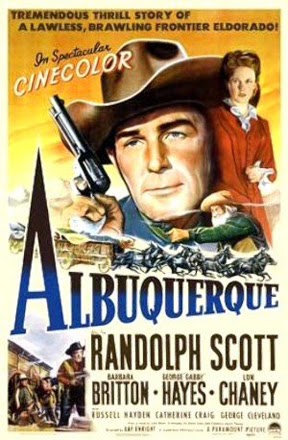
ALBUQUERQUE (Paramount, 1948)

Director: Ray Enright;  Producers: William H. Pine and William C. Thomas; Writers: screenplay by Gene Lewis and Clarence Upson Young based on Luke Short novel, Dead Freight for Piute;  Cinematographer: Fred Jackman, Jr.

Starring: Randolph Scott and Barbara Britton


The team of Scott and Enright had done good work before this film and would do even better the following year.

"It might be remarked in passing that the picture is neither especially good nor bad, as Westerns go; that Randolph Scott ... seems well able to take care of himself in the clinches .... And, yes, there is some shooting and a runaway stage to liven up the proceedings.  But even that doesn't help much."  -- The New York Times


CORONER CREEK (Columbia, 1948)

Director: Ray Enright;  Producer: Harry Joe Brown;  Writers: screenplay by Kenneth Gamet based on Luke Short novel of same name; Cinematographer: Fred Jackman, Jr.

Starring: Randolph Scott, Marguerite Chapman, and Forest Tucker

Scott and Tucker engage in two brutal fights.  One is depicted in the upper right corner of the above poster.

"Solid little Western; Scott's fisticuffs with henchman Tucker are a highlight." -- Leonard Maltin


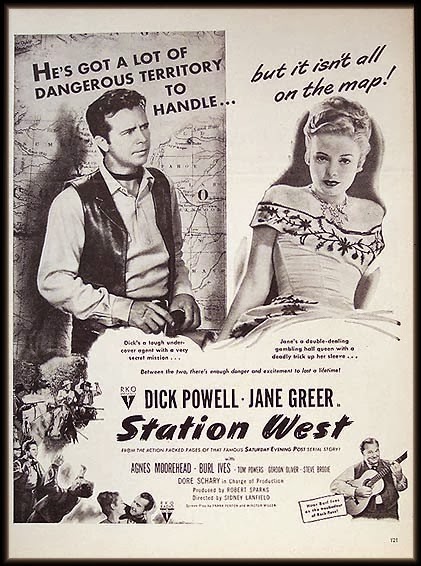
STATION WEST (RKO, 1948)

Director: Sidney Lanfield;  Producer: Robert Sparks;  Writers: screenplay by Frank Fenton and Winston Miller based on Luke Short novel of same name;  Cinematographer: Harry J. Wild

Starring: Dick Powell and Jane Greer

This was Powell's only true Western role.  Perhaps it is a case of lowered expectations, but he was far better and much more believable than anyone had any right to expect.

Colin at Riding the High Country has a review of this unique Western. 


BLOOD ON THE MOON (RKO, 1948)

Director: Robert Wise;  Producer: Theron Warth;  Writers: screenplay by Lillie Hayward; adaptation by Luke Short and Harold Shumate based on Luke Short novel, Gunman's Chance, later re-issued as Blood on the Moon; Cinematographer: Nicholas Musuraca

Starring: Robert Mitchum, Barbara Bel Geddes, and Robert Preston


"BLOOD ON THE MOON is a terse, tightly-drawn Western drama.  There's none of the formula approach to its story telling.  Picture captures the crisp style used by Luke Short in writing his Western novels." -- Variety 

You can read my review of the film here. 


AMBUSH (MGM, 1950)

Director: Sam Wood;  Producers: Armand Deutsch and Sam Wood; Writers: screenplay by Marguerite Roberts based on Luke Short novel of same name;  Cinematographer: Harold Lipstein

Starring: Robert Taylor, John Hodiak, and Arlene Dahl

The poorly cast film is notable only for being the last film for director Wood.

"...the action, though fast towards the finish, is decidedly meager in this film, and Mr. Taylor is a flattire as a hero [Ouch!]." -- Bosley Crowther in The New York Times


VENGEANCE VALLEY (MGM, 1951)

Director: Richard Thorpe;  Producer: Nicholas Nayfack;  Writers: screenplay by Irving Ravetch based on Luke Short novel of same name; Cinematographer: George J. Folsey

Starring: Burt Lancaster, Robert Walker, and Joanne Dru


"This wasn't the best of the Luke Short novels and it's not the best of the movies made from his books, but it's not bad, though it's more soap than horse opera." -- Brian Garfield in Western Movies: A Complete Guide


SILVER CITY (Paramount, 1951)

Director: Bryan Haskin;  Producer: Nat Holt;  Writers:  screenplay by Frank Gruber based on Luke Short novel, High Vermillion; Cinematographer: Ray Rennahan

Starring: Edmond O'Brien, Yvonne De Carlo, and Barry Fitzgerald

This is undoubtedly the weakest of all the films based on a Luke Short story.  It is poorly cast, weakly acted, ineptly directed, and Gruber's screenplay took all the flavor out of Short's novel.  I have tried -- really tried -- but I have never been able to sit all the way through it.  The only good thing that I can say about what I have seen is that Rennahan, as usual, did a superb job of photographing the film.


RIDE THE MAN DOWN (Republic, 1952)

Director: Joseph Kane;  Producer: Joseph Kane;  Writers: screenplay by Mary C. McCall, Jr. based on Luke Short novel of same name;  Cinematographer: Jack A. Marta

Starring: Rod Cameron, Brian Donlevy, and Ella Raines


"McCall's screenplay is a perfect distillation of the flavor and complication of the novel.  Kane's direction is swift and sure.  The music is unobtrusive but proper, and the photography is thoroughly craftsmanlike." -- Brian Garfield in Western Movies: A Complete Guide


Hell's Outpost (Republic, 1954)

Director: Joseph Kane;  Producer: Joseph Kane;  Writers: screenplay by Kenneth Gamet based on Luke Short novel, Silver RockCinematographer: Jack A. Marta

Starring: Rod Cameron and Joan Leslie

This is a modern day mining story capably handled by all concerned.


The Hangman (Paramount, 1959)

Director: Michael Curtiz;  Producer: Frank Freeman, Jr.;  Writers: screenplay by Dudley Nichols based on story by Luke Short; Cinematograper: Loyal Griggs

Starring: Robert Taylor and Tina Louise


The film has a decent cast and Dudley Nichols was an accomplished screenwriter, but Michael Curtiz's direction of Western films always left much to be desired.