THE AMERICAN WEST (mostly): Fact and Fiction (mostly fiction)


"NOBODY GETS TO BE A COWBOY FOREVER." -- Chet Rollins (Jack Palance) in MONTE WALSH (NG, 1970)

Total Pageviews

Showing posts with label erskine caldwell. Show all posts

Sunday, July 12, 2015

YOU HAVE SEEN THEIR FACES by Erskine Caldwell and Margaret Bourke-White


The sharecropping system was born of the plantation system, and the new was anything but an improvement over the old. The old produced numerous families of wealth who developed a culture that was questionable. The new concentrated wealth in the hands of a few families who are determined that no culture shall exist. -- Erskine Caldwell, You Have Seen Their Faces (Viking Press, 1937)

The idea for this book originated with Erskine Caldwell, who wanted "to show that the fiction I was writing was authentically based on contemporary life in the South." Needing a photographer to accompany him on a tour of the South to document through words and pictures the lives of southern tenant farmers, his agent suggested Margaret Bourke-White, already famous for her photos that had appeared in Fortune and Life.

During the summer of 1936 and early 1937, the two traveled from South Carolina to Arkansas interviewing and photographing poor white and black tenant farmers and their families.

Historian Alan Trachtenberg writes in the introduction of my copy of the book that when it was first published that it "struck viewers as a new kind of book, one in which pictures appeared on an equal basis with words" and that through Caldwell's prose and Bourke-White's images it can be viewed as "a long-lost moment of artistic protest against economic injustice and suffering" and that "whatever shortcomings new readers may find in the book, its evidence of a passion for justice joined with a passion for artistic communication makes an irresistible claim on our respect." As such, it was very much considered to be radical for its time.

Readers then and now have been confused by Caldwell's fiction. While he claimed to sympathize with the poor sharecroppers and their families, he nevertheless seemed to be poking fun at them in his novels. Readers searching for stories about the suffering of the noble poor during the Great Depression had to look elsewhere. The poor in Caldwell's novels were anything but noble.

So, what was his personal opinion of poor sharecroppers? And who did he really blame for their poverty and their ignorance?

The answer to those questions may not be clear in his novels, but he makes it crystal clear in this book. It was the landowners, he wrote, "who are to be held responsible, and in the end to be called upon to answer for the degeneration of men as well as the rape of the soil in the South."

Conversely, the sharecroppers, the people who shared in the risk, but not the control, "are the wasted human beings whose blood made the cotton leaves green and the blossoms red. To the cost of raising cotton add the value of lives."

******
Many of the Bourke-White photos that appear in the book can be viewed at the link below along with some that appeared in Agee and Evans' Let Us Now Praise Famous Men:

https://www.google.com/search?q=you+h...


Wednesday, June 10, 2015

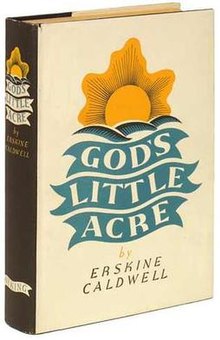
GOD'S LITTLE ACRE -- by Erskine Caldwell


"What William Faulkner implies, Erskine Caldwell records." -- Chicago Tribune

"Caldwell writes with a full-blooded gutsy vitality that makes him akin to the truly great." -- San Francisco Chronicle

At one time, and maybe even today, God's Little Acre (1932) was the most popular novel ever published, selling a reported fourteen million copies.  But in the process, the book ignited a firestorm of controversy, leading to numerous efforts to suppress it.

A year earlier, Caldwell's Tobacco Road was published.  It had become a runaway best-seller after it was adapted as a stage play.  When the play ended its long run years later, it was the longest-running play in Broadway's history.  The play spurred book sales and eventually ten million copies were sold.

Caldwell's portrayal of poor white southern tenant farmers who had been exploited by their landlords outraged many southerners and received mixed reviews from critics.  There were also charges that its explicit sexual scenes constituted obscenity and it was banned from many libraries, including in his hometown, and efforts were made to suppress it elsewhere.

That was only the beginning.  God's Little Acre was even more controversial.

Once again Caldwell wrote about the dire straits of poor white rural people who when faced with choices rarely chose the right one.  But it also focuses on southern textile mill hands who are exploited by their employers.  At one plant the workers strike for higher wages and a shorter work week, but because they are deprived of union protection the owners lock them out and shut down the mill. 

There is no doubt that Caldwell was influenced by several strikes by southern textile workers that occurred in the late '20's and early '30's, strikes that were in response to the fact that they were the lowest paid textile workers in the nation. 

While Caldwell again presented his story as a curious combination of black humor and tragedy, a combination that confuses critics -- not to mention readers -- God's Little Acre becomes very serious -- deadly serious -- when it turned from the humorous efforts of Ty Ty Walden and his sons to find gold on their farm to an attempt by Ty Ty's son-in-law to forcibly re-open the textile plant that has kept him and his co-workers unemployed for a year and a half.

The sexual scenes in God's Little Acre  are even more explicit than in  Tobacco Road.  And while they are relatively mild by today's standards, they were not mild by the standards of that day.

In 1933, Caldwell and his publisher, Viking Press, were hauled into court on a charge of disseminating pornography.  It was reported that more than sixty writers, editors, and literary critics rallied to his support.  Caldwell's defense was that if his book was obscene it was because the truth was obscene.  The judge ruled in his favor, declaring that the book was literature and not pornography.  However, that did not deter other efforts to suppress the book.  But what would-be book banners never seem to learn is that all that publicity spurs sales and the novel became not only Caldwell's biggest seller, but one of the biggest ever.

The book was still very controversial many, many years later and that is why I tucked my copy inside my lit book during my sophomore year in high school.  I knew that it was going to be a lot more interesting than my assigned reading.  Well, I must confess that it wasn't just the controversy.  It was also the lurid cover featuring a scantily-clad, well-endowed young lady on the cover of the paperback re-issue that I possessed.  But that's another story. 

You probably already know the meaning of the book's title by now, but if not, I don't wish to be a spoiler.  I'll let the publisher's blurb describing the book do that.


Monday, June 1, 2015

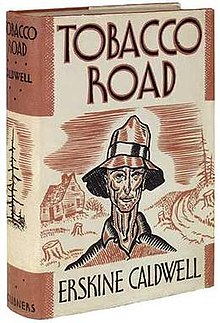
TOBACCO ROAD by Erskine Caldwell


 Nathaniel Rich writes on The Daily Beast website, "As a comedy, Tobacco Road is a modest failure; as a tragedy, it is an abject failure" and that the novel is "as indelible as a freak show or car crash."  Dwight Garner on the Slate website called it "a greasy hairball of a novel....one of the sickest and most lurid books to have emerged from the literature of the American South."  Both writers, however, proceed to give the novel a generally positive review.  Their conflicted response is typical of both critics and readers.
 
Experts, however, have ranked it as one of the hundred most significant novels written in English in the 20th century.  And, especially after its success as a Broadway play, the novel eventually sold ten million copies.

Rich goes on to say that Erskine Caldwell is a "progenitor of what could be called the degenerate school of American fiction," which I suppose could be called a subgenre of the so-called grit-lit genre.  At any rate, it seems that a straight line can be drawn from Caldwell to writers such as Harry Crews, who also attempted to combine tragedy and comedy in their novels.

Tobacco Road, published in 1932, was meant to be a work of social protest, a condemnation of poverty among the poor whites of the Deep South.  John Steinbeck wrote about some of the same issues a few years later in The Grapes of Wrath.  But it is only on the surface that the two books are similar.   Unlike Steinbeck, Caldwell refused to resort to sentimentality or to imbue his characters with any degree of dignity in coping with their suffering.  Other than poverty and being dispossessed of their land, Caldwell's Lesters share very little in common with Steinbeck's Joads. 

Most readers, and I include myself, struggle with Caldwell's depiction of the Lesters as being "ignorant, selfish, crude, sexually promiscuous, indecent, but also comic figures."  Caldwell seems to simultaneously sympathize with his characters while at the same time maintaining a disdainful attitude toward them.  It is call for social action to combat poverty, but one that provides no solutions to the problem. 
 
Caldwell claimed that he wrote the novel as "a rebuke of the perfumed 'moonlight and magnolias' literature of the South."  Well, it was that.

And there is this, too: it was edited by Maxwell Perkins; William Faulkner and Malcolm Cowley admired the book; and Saul Bellow thought Caldwell should have been awarded the Nobel Prize.


Wednesday, May 27, 2015

ERSKINE CALDWELL: The Journey From Tobacco Road by Dan B. Miller


Erskine Caldwell wrote 25 novels, 12 nonfiction books, and 150 short stories.  By the late 1940s, he had sold more books than any other American writer and by 1960 his sales exceeded 60 million.

However, Dan B. Miller confesses that prior to 1989 he had never even heard of Caldwell.  He only became aware of him when he read that the writer's papers had been deposited at Dartmouth College and would be available to researchers.

"His name did not ring a bell.  I had never come across one of his novels in a bookstore, nor seen his name in an anthology, syllabus, or critical evaluation of American literature.  Neither had most of my peers, although a few claimed to have heard of (but not read) a novel called Tobacco Road....

An index of American best-sellers confirmed that Caldwell's books had sold a staggering 70 million copies.  Although most of his success had taken place in the late 1940s and 1950s, one Caldwell novel, God's Little Acre, still ranked as high in total sales as any single work by Faulkner, Hemingway, Fitzgerald, or Steinbeck."

What emerges from Miller's thoroughly researched and very readable -- and long overdue -- biography (published in 1994) is the portrait of a writer who was as flawed and as contradictory, but also as memorable, as the characters he created.

Because his fiction is a curious mixture of comedy and tragedy, he is a writer that critics always struggled to pigeonhole.  He specialized in writing about "po' white" southerners, people whose plight he sympathized with, while at the same time he could not help viewing them with disdain and little or no affection.
  
He went to court several times to keep his books from being banned on obscenity charges.  His defense was that if his books were obscene it was only because the truth was obscene.  He won every case.

There was even a time that critics ranked him as the third member, along with Faulkner and Wolfe, in a great triumvirate of southern novelists.  However, Miller writes that "[t]oday Erskine Caldwell has been virtually forgotten by popular readers and scholarly critics alike, and he surely represents one of the greatest disappearing acts in our literary history."

One of the strengths of Miller's book results from the fact that he had heretofore been ignorant of Caldwell's career.  That allowed him to approach his subject clear-eyed and with no preconceptions as he conducted his research and read Caldwell's work for the first time.

And thanks to Miller's discovery, we now have a better understanding of why Caldwell rose so high and fell so far.