# 1
THE SEARCHERS (WB/C.V. Whitney, 1956)

DIRECTOR: John Ford; EXECUTIVE PRODUCER: Merian C. Cooper; ASSOCIATE PRODUCER: Patrick Ford; WRITER: Frank S. Nugent from story by Alan Le May; CINEMATOGRAPHER: Winton Hoch; STUNTS: Chuck Hayward, Chuck Roberson, Slim Hightower, Fred Kennedy, Cliff Lyons, Frank McGrath, Dale van Sickel, Henry Wills, Terry Wilson, John Hudkins
CAST: John Wayne, Jeffrey Hunter, Vera Miles, Ward Bond, John Qualen, Olive Carey, Henry Brandon, Ken Curtis, Harry Carey, Jr., Antonio Moreno, Hank Worden, Beulah Archuletta, Walter Coy, William Steele, Dorothy Jordan, Pippa Scott, Patrick Wayne, Lana Wood, Danny Borzage, Ruth Clifford, Chuck Hayward, Cliff Lyons, Mae Marsh, Frank McGrath, Jack Pennick, Chuck Roberson, Terry Wilson
What a surprise! THE SEARCHERS is number one! Well, not really a surprise, of course. Entertainment Weekly has not only named it the greatest Western of all time but also the thirteenth greatest movie ever made. In 2007, the American Film Institute ranked it as the twelfth greatest film ever produced and a year later bestowed the honor of naming it the greatest Western film. Film critic Roger Greenspan of the New York Times even went so far as to name it the greatest American film. So, who am I to argue?
However, it hasn't always been held in such high esteem. Despite some commercial success and some good reviews, it did not win a single Academy Award. It did not even receive one nomination.
There is also the implication that Ethan was in love with his sister-in-law, Martha, and that she probably felt the same about him. Wayne in an interview indicated that Ford viewed that as being the case and that Lucy and Debbie may have been Ethan's daughters. In Alan Le May's novel, however, there is no doubt that Ethan (Amos in the novel) loved Martha, but neither she nor her husband was ever aware of that love and Lucy and Debbie were definitely not his daughters.
REVEREND SAMUEL CLAYTON (Ward Bond): "You wanna quit, Ethan?"
ETHAN EDWARDS (John Wayne): "That'll be the day."
Ethan sets off with his adopted nephew Martin Pawley (Hunter) on a five-year odyssey to find Debbie. Ethan wishes to kill her because she has been defiled by the Indians, while Martin, who is himself part Indian, wishes to prevent him from doing so.
MARTIN PAWLEY (Jeffrey Hunter): "I hope you die!"
ETHAN EDWARDS (John Wayne): "That'll be the day."

DIRECTOR: John Ford; EXECUTIVE PRODUCER: Merian C. Cooper; ASSOCIATE PRODUCER: Patrick Ford; WRITER: Frank S. Nugent from story by Alan Le May; CINEMATOGRAPHER: Winton Hoch; STUNTS: Chuck Hayward, Chuck Roberson, Slim Hightower, Fred Kennedy, Cliff Lyons, Frank McGrath, Dale van Sickel, Henry Wills, Terry Wilson, John Hudkins
CAST: John Wayne, Jeffrey Hunter, Vera Miles, Ward Bond, John Qualen, Olive Carey, Henry Brandon, Ken Curtis, Harry Carey, Jr., Antonio Moreno, Hank Worden, Beulah Archuletta, Walter Coy, William Steele, Dorothy Jordan, Pippa Scott, Patrick Wayne, Lana Wood, Danny Borzage, Ruth Clifford, Chuck Hayward, Cliff Lyons, Mae Marsh, Frank McGrath, Jack Pennick, Chuck Roberson, Terry Wilson
What a surprise! THE SEARCHERS is number one! Well, not really a surprise, of course. Entertainment Weekly has not only named it the greatest Western of all time but also the thirteenth greatest movie ever made. In 2007, the American Film Institute ranked it as the twelfth greatest film ever produced and a year later bestowed the honor of naming it the greatest Western film. Film critic Roger Greenspan of the New York Times even went so far as to name it the greatest American film. So, who am I to argue?
However, it hasn't always been held in such high esteem. Despite some commercial success and some good reviews, it did not win a single Academy Award. It did not even receive one nomination.
It was John Wayne's greatest
performance (also his personal favorite), but he wasn't nominated.
Neither was John Ford, who in his career won four Oscars for Best Director, but
wasn't even nominated for this one. One would have thought that at the
very least Winton Hoch would have been nominated for his stunning shots of the
majestic Monument Valley vistas. However, he struck out as well.
REVEREND SAMUEL CLAYTON (Ward Bond): "Well, the prodigal brother. When did you get back? Ain't seen you since the surrender. Come to think of it, I didn't see you at the surrender."
ETHAN EDWARDS (John Wayne): "I don't believe in surrendering. Nope, I've still got my saber, Reverend. Didn't beat it into no plowshare, neither."
REVEREND SAMUEL CLAYTON (Ward Bond): "Well, the prodigal brother. When did you get back? Ain't seen you since the surrender. Come to think of it, I didn't see you at the surrender."
ETHAN EDWARDS (John Wayne): "I don't believe in surrendering. Nope, I've still got my saber, Reverend. Didn't beat it into no plowshare, neither."
 |
| Martha (Dorothy Jordan) watches as her brother-in-law Ethan (John Wayne) appears after a long absence |
THE PLOT.
Ethan Edwards (Wayne) is a nomad who has not been seen nor heard from since the American Civil War ended three years earlier. Apparently, he had spent those years as a combatant in Mexico's civil war.
Ethan Edwards (Wayne) is a nomad who has not been seen nor heard from since the American Civil War ended three years earlier. Apparently, he had spent those years as a combatant in Mexico's civil war.
Soon after
he rather mysteriously appears at his brother's Texas home (which looks a lot more
like Monument Valley than western Texas), the Comanches attack and kill most of
his family and kidnap his two nieces, Lucy (Scott) and Debbie (Wood).
Lucy's body is soon discovered, but it is assumed that Debbie has become a
captive.
Ethan is an avowed Indian-hater and though it is not readily apparent he does have his reasons. In the scene in which young Debbie is hiding in the cemetery there is a momentary glimpse of a tombstone that easily escapes the attention of all but the most attentive viewers. It is inscribed: "Here lies Mary Jane Edwards killed by Comanches May 12, 1852. A good wife and mother in her 41st year." Mary Jane Edwards was Ethan's mother.
By the same token, Ethan's main adversary, the Comanche chief Scar (Brandon), has his reasons for hating whites. They were responsible for the deaths of his two sons. Therefore, these are two embittered, troubled, and unforgiving men whose hatred and bitterness are not entirely unreasonable or irrational, but in fact have some basis in reality.'
Ethan is an avowed Indian-hater and though it is not readily apparent he does have his reasons. In the scene in which young Debbie is hiding in the cemetery there is a momentary glimpse of a tombstone that easily escapes the attention of all but the most attentive viewers. It is inscribed: "Here lies Mary Jane Edwards killed by Comanches May 12, 1852. A good wife and mother in her 41st year." Mary Jane Edwards was Ethan's mother.
By the same token, Ethan's main adversary, the Comanche chief Scar (Brandon), has his reasons for hating whites. They were responsible for the deaths of his two sons. Therefore, these are two embittered, troubled, and unforgiving men whose hatred and bitterness are not entirely unreasonable or irrational, but in fact have some basis in reality.'
 |
| The Reverend Samuel Clayton (Ward Bond) clearly suspects that more than a platonic affection exists between Ethan and Martha. In fact, I think that he has more than a suspicion. |
There is also the implication that Ethan was in love with his sister-in-law, Martha, and that she probably felt the same about him. Wayne in an interview indicated that Ford viewed that as being the case and that Lucy and Debbie may have been Ethan's daughters. In Alan Le May's novel, however, there is no doubt that Ethan (Amos in the novel) loved Martha, but neither she nor her husband was ever aware of that love and Lucy and Debbie were definitely not his daughters.
REVEREND SAMUEL CLAYTON (Ward Bond): "You wanna quit, Ethan?"
ETHAN EDWARDS (John Wayne): "That'll be the day."
Ethan sets off with his adopted nephew Martin Pawley (Hunter) on a five-year odyssey to find Debbie. Ethan wishes to kill her because she has been defiled by the Indians, while Martin, who is himself part Indian, wishes to prevent him from doing so.
 |
| Hunter and Wayne as uneasy allies |
MARTIN PAWLEY (Jeffrey Hunter): "I hope you die!"
ETHAN EDWARDS (John Wayne): "That'll be the day."
THE ACTORS.
If
there is still anyone who thinks that John Wayne could not act or if they are only
familiar with his performances in some of the routine, mediocre Westerns at the
end of his career, they owe it to themselves (and Wayne) to watch THE
SEARCHERS. He submerges himself into the role to such a degree that
he becomes Ethan Edwards, the most complex character he was ever
asked to portray. In fact, so good is he that it is easy to forget that
he is acting. And after all, isn't that a hallmark of great acting?
According to Fess Parker, he was Ford's first choice to play Martin. However, the actor was at the crest of the Davy Crockett wave and Disney refused to give him permission to appear in the film. However, after viewing Jeffrey Hunter in the role, I have a hard time seeing Parker as Martin. Hunter was very good and, unfortunately, Parker had become typecast. It is also true that he was not as talented an actor as Hunter.
Hunter appeared in two other Ford films. In 1958, he supported Spencer Tracy in THE LAST HURRAH (Columbia) and two years later starred in SERGEANT RUTLEDGE (WB/Ford). He was only 42 when he died in 1969.
REVEREND SAMUEL CLAYTON (Ward Bond): "I say we do it my way. That's an order!"
ETHAN EDWARDS (John Wayne): "Yessir. But if you're wrong don't ever give me another!"
THE WRITERS.
 William
T. Pilkington writes in Twentieth-Century Western Writers: "Alan
Le May was a writer of formula Westerns who created one excellent book -- The
Searchers [Le May's twelfth novel, published in 1954] --
that artistically and literarily soars far beyond anything else he ever published....
William
T. Pilkington writes in Twentieth-Century Western Writers: "Alan
Le May was a writer of formula Westerns who created one excellent book -- The
Searchers [Le May's twelfth novel, published in 1954] --
that artistically and literarily soars far beyond anything else he ever published....
"Following The Searchers, Le May brought out The Unforgiven [published in 1957] which was also made into a well-known motion picture [directed by John Huston and starring Burt Lancaster, Audrey Hepburn, and Audie Murphy]. Again set in the Texas Panhandle during the Indian wars of the 19th century, The Unforgiven explores essentially the same ideas as those developed in The Searchers. Unfortunately, the later novel is much less impressive than its predecessor. Le May appears to be an example of a not-unusual kind of writer who toils unobtrusively at his craft for years, and is finally rewarded at the close of a long career with one superb book. That is enough; we, as readers, should be grateful."
Le May's story was inspired by the real-life capture of nine-year-old Cynthia Ann Parker in 1836. She lived for twenty-four years with the Comanche and gave birth to three children.
Unlike Debbie Edwards in Le May's novel and Ford's film, Cynthia Parker was rescued against her will by Texas Rangers and longed to rejoin "her people" and her son Quanah, who grew up to become the last Comanche war chief. Amos (Ethan) Edwards was loosely based on Cynthia's uncle, James W. Parker, a Texas Ranger who engaged in a forty-year blood feud with the Comanches and spent eight years obsessively searching for his niece.
MOSE HARPER (Hank Worden) [just before an Indian attack]: "That which we are about to receive, we thank thee, O Lord."
Some reviewers were critical of what they perceived as Hank Worden's unrealistic portrayal of Mose Harper, a half-mad
Indian-fighting Texan who longed for
"a roof over my head and a rocking chair by the fire."
However, he was also based on a historical figure known as "Mad Mose,"
a Texas Indian fighter who was said to have had affection for rocking chairs.
Frank Nugent was a former film critic who wrote hundreds of film reviews for the New York Times. He could be harshly critical in his assessments but he was an ardent admirer of John Ford's work and was especially effusive in his praise for STAGECOACH (UA, 1939) and THE GRAPES OF WRATH (Fox, 1940).
After moving to Hollywood, he began a new career as a screenwriter. Of the twenty-one scripts that he wrote, eleven were for Ford, including THE QUIET MAN (Republic/Argosy, 1952), for which he received his only Academy Award nomination.
A FAMILY AFFAIR.
Even to a greater extent than on other Ford films, THE SEARCHERS is a web of family connections.
According to Fess Parker, he was Ford's first choice to play Martin. However, the actor was at the crest of the Davy Crockett wave and Disney refused to give him permission to appear in the film. However, after viewing Jeffrey Hunter in the role, I have a hard time seeing Parker as Martin. Hunter was very good and, unfortunately, Parker had become typecast. It is also true that he was not as talented an actor as Hunter.
Hunter appeared in two other Ford films. In 1958, he supported Spencer Tracy in THE LAST HURRAH (Columbia) and two years later starred in SERGEANT RUTLEDGE (WB/Ford). He was only 42 when he died in 1969.
REVEREND SAMUEL CLAYTON (Ward Bond): "I say we do it my way. That's an order!"
ETHAN EDWARDS (John Wayne): "Yessir. But if you're wrong don't ever give me another!"
 |
| Ward Bond is the Reverend Samuel Johnson Clayton, Texas Rangers captain |
The role of the Reverend Samuel Johnson Clayton, a captain in the
Texas Rangers, is one of Ward Bond's finest performances. The only two
that I can think of that came close were his Sergeant Major O'Rourke in FORT
APACHE
(RKO/Argosy, 1948) and Elder Wiggs in WAGON
MASTER (RKO/Argosy, 1950). It is no coincidence that John Ford
directed all three films.
 |
| As usual in a Ford Western, the Indians, Apache or Comanche, are portrayed by Navajos. The one exception is Chief Scar, who is portrayed by Henry Brandon, a native of Germany. |
THE WRITERS.

"Following The Searchers, Le May brought out The Unforgiven [published in 1957] which was also made into a well-known motion picture [directed by John Huston and starring Burt Lancaster, Audrey Hepburn, and Audie Murphy]. Again set in the Texas Panhandle during the Indian wars of the 19th century, The Unforgiven explores essentially the same ideas as those developed in The Searchers. Unfortunately, the later novel is much less impressive than its predecessor. Le May appears to be an example of a not-unusual kind of writer who toils unobtrusively at his craft for years, and is finally rewarded at the close of a long career with one superb book. That is enough; we, as readers, should be grateful."
Le May's story was inspired by the real-life capture of nine-year-old Cynthia Ann Parker in 1836. She lived for twenty-four years with the Comanche and gave birth to three children.
Unlike Debbie Edwards in Le May's novel and Ford's film, Cynthia Parker was rescued against her will by Texas Rangers and longed to rejoin "her people" and her son Quanah, who grew up to become the last Comanche war chief. Amos (Ethan) Edwards was loosely based on Cynthia's uncle, James W. Parker, a Texas Ranger who engaged in a forty-year blood feud with the Comanches and spent eight years obsessively searching for his niece.
MOSE HARPER (Hank Worden) [just before an Indian attack]: "That which we are about to receive, we thank thee, O Lord."
Some reviewers were critical of what they perceived as Hank Worden's unrealistic portrayal of Mose Harper, a half-mad
 |
| Ol' Mose |
Frank Nugent was a former film critic who wrote hundreds of film reviews for the New York Times. He could be harshly critical in his assessments but he was an ardent admirer of John Ford's work and was especially effusive in his praise for STAGECOACH (UA, 1939) and THE GRAPES OF WRATH (Fox, 1940).
After moving to Hollywood, he began a new career as a screenwriter. Of the twenty-one scripts that he wrote, eleven were for Ford, including THE QUIET MAN (Republic/Argosy, 1952), for which he received his only Academy Award nomination.
A FAMILY AFFAIR.
Even to a greater extent than on other Ford films, THE SEARCHERS is a web of family connections.
Wingate Smith, Ford's long-time
assistant director, was also his brother-in-law. Ford's son, Patrick, was
the film's associate producer. Ken Curtis, who played Texas Ranger
Charlie McCorry, Martin's rival for the hand of Laurie Jorgenson (Vera Miles),
was Ford's son-in-law. John Wayne's son, Patrick, has a small part as a
greenhorn cavalry lieutenant. Harry Carey, Jr. and his mother, Olive,
have suppporting roles while sisters Lana and Natalie Wood play Debbie Edwards at
different ages. Finally, Dorothy Jordan, who portrays Martha Edwards, was the wife of producer Merian Cooper.
******
******
REVIEWS:
"THE SEARCHERS is undeniably, and wonderfully, a masterpiece....It unquestionably is one of the few Westerns that deserve to be regarded as important works of art. In many ways it is the quintessential John Ford movie....The best of John Ford and the best of John Wayne." -- Brian Garfield in Western Films: A Complete Guide
"John Ford's THE SEARCHERS contains scenes of magnificence, and one of John Wayne's best performances. Ethan Edwards is one of the most compelling characters Ford and Wayne ever created....we can see Ford, Wayne, and the Western itself, awkwardly learning that a man who hates Indians can no longer be an uncorrupted hero." -- Roger Ebert in the Chicago Sun-Times
"John Wayne is uncommonly commanding as the Texan whose passion for revenge is magnificently uncontaminated by caution or sentiment. Jeffrey Hunter is wonderfully callow and courageous as the lad who goes with him, and Ward Bond makes a dandy fighting parson in an old plug hat and a long linen coat." -- Bosley Crowther in the New York Times
"Color, scenery, photography all splendid, with moving, insightful Frank Nugent script to match. And who could ever forget that final shot? Remade [unofficially] and imitated many other times since...." -- Leonard Maltin
"....is as far from an ordinary mid-century Western as King Lear is from a soap opera....with Wayne at the center in arguably the most profound portrait of macho monstrosity ever delivered by an American movie star." -- Michael Atkinson in The Village Voice
"Ford's masterpiece." -- Phil Hardy in The Western
"Masterpiece isn't a word to be used lightly but few would quarrel about applying it here. -- Walter C. Clapham in Western Movies
"No director made better Westerns than John Ford, and many would argue that THE SEARCHERS is the best he ever made....Wayne never topped his work as Edwards, a subtle and skilled portrayal that reveals both the dark and heroic sides of the archetypal Western loner." -- Steven H. Scheuer
"THE SEARCHERS...is a melancholic yet enthralling film that is stupefyingly in its beauty....John Wayne...has given what surely must be one of his best screen characterizations, if not the greatest. The moment that he resists shooting his niece because of her wishing to live with an Indian warrior is one of the greatest moments in Western cinema." -- Les Adams and Buck Rainey in Shoot-Em-Ups
Now for a little fly in the ointment provided by Stephen Metcalf in his July 2006 review in Slate in which he at one point refers to THE SEARCHERS as "this silly film":
"[It] is a geek's paradise: It is preposterous in its plotting, spasmodic in its pacing, unfunny in its hijinks, bipolar in its politics, alternately sodden and convulsive in its acting, not to mention boring."
However, he does make one small concession regarding the film, writing that the climatic scenes featuring John Wayne and Natalie Wood are "among the most thrilling moments" to ever be filmed.
Well, at least there's that.
"THE SEARCHERS is undeniably, and wonderfully, a masterpiece....It unquestionably is one of the few Westerns that deserve to be regarded as important works of art. In many ways it is the quintessential John Ford movie....The best of John Ford and the best of John Wayne." -- Brian Garfield in Western Films: A Complete Guide
"John Ford's THE SEARCHERS contains scenes of magnificence, and one of John Wayne's best performances. Ethan Edwards is one of the most compelling characters Ford and Wayne ever created....we can see Ford, Wayne, and the Western itself, awkwardly learning that a man who hates Indians can no longer be an uncorrupted hero." -- Roger Ebert in the Chicago Sun-Times
"John Wayne is uncommonly commanding as the Texan whose passion for revenge is magnificently uncontaminated by caution or sentiment. Jeffrey Hunter is wonderfully callow and courageous as the lad who goes with him, and Ward Bond makes a dandy fighting parson in an old plug hat and a long linen coat." -- Bosley Crowther in the New York Times
"Color, scenery, photography all splendid, with moving, insightful Frank Nugent script to match. And who could ever forget that final shot? Remade [unofficially] and imitated many other times since...." -- Leonard Maltin
"....is as far from an ordinary mid-century Western as King Lear is from a soap opera....with Wayne at the center in arguably the most profound portrait of macho monstrosity ever delivered by an American movie star." -- Michael Atkinson in The Village Voice
"Ford's masterpiece." -- Phil Hardy in The Western
"Masterpiece isn't a word to be used lightly but few would quarrel about applying it here. -- Walter C. Clapham in Western Movies
"No director made better Westerns than John Ford, and many would argue that THE SEARCHERS is the best he ever made....Wayne never topped his work as Edwards, a subtle and skilled portrayal that reveals both the dark and heroic sides of the archetypal Western loner." -- Steven H. Scheuer
"THE SEARCHERS...is a melancholic yet enthralling film that is stupefyingly in its beauty....John Wayne...has given what surely must be one of his best screen characterizations, if not the greatest. The moment that he resists shooting his niece because of her wishing to live with an Indian warrior is one of the greatest moments in Western cinema." -- Les Adams and Buck Rainey in Shoot-Em-Ups
Now for a little fly in the ointment provided by Stephen Metcalf in his July 2006 review in Slate in which he at one point refers to THE SEARCHERS as "this silly film":
"[It] is a geek's paradise: It is preposterous in its plotting, spasmodic in its pacing, unfunny in its hijinks, bipolar in its politics, alternately sodden and convulsive in its acting, not to mention boring."
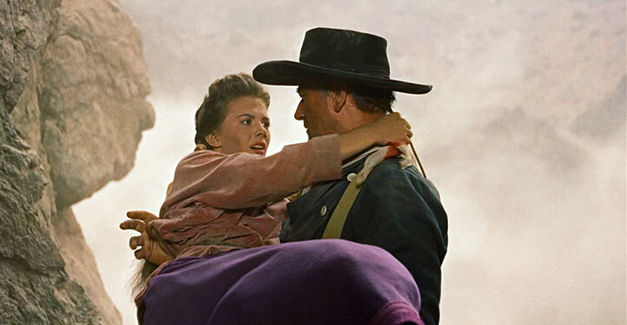 |
| Debbie and Ethan |
However, he does make one small concession regarding the film, writing that the climatic scenes featuring John Wayne and Natalie Wood are "among the most thrilling moments" to ever be filmed.
Well, at least there's that.
 |
| The famous final scene in which Wayne pays homage to the late Harry Carey, Sr. by grasping his right elbow with his left hand, a gesture closely associated with Carey. Carey's widow and son had prominent roles in the film. |


