DIRECTOR: Anthony Mann; Producer: Aaron Rosenberg; WRITERS: screenplay by Robert L. Richards and Borden Chase based on story by Stuart N. Lake; CINEMATOGRAPHER: William Daniels
CAST: James Stewart, Shelley Winters, Dan Duryea, Stephen McNally, Millard Mitchell, Charles Drake, John McIntire, Will Geer, Jay C. Flippen, Rock Hudson, John Alexander, Steve Brodie, James Millican, Abner Biberman, Tony Curtis, James Best, Guy Wilkerson
THE ACTOR
James Stewart had been to war and now five years later his career was in the doldrums. He was still making the entertaining light hearted comedies that he had specialized in before the war, but they weren't doing all that well at the box-office. Even the Frank Capra film that he starred in, IT'S A WONDERFUL LIFE (Liberty/RKO, 1946), was a disappointment, never mind that it later became a cult classic.
He had just completed filming a Western, BROKEN ARROW (Fox, 1950), and he had high hopes for it. Directed by Delmer Daves, it was a message film about Indian-white relations, but it had yet to be released.
It was his second Western, but his first since 1939. That had been the comedy spoof of the genre, DESTRY RIDES AGAIN (Universal), directed by George Marshall. It had been a good film, but in keeping with the Stewart persona it was a story about a lawman who succeeds by outwitting the bad guys.
At one point after the war, he had taken a break from Hollywood and had starred on the stage in a play, HARVEY, a comedy that was ideally suited for his whimsical screen personality. He thought that starring in a film version just might get his movie career back on track.
His agent, Lew Wasserman, approached William Goetz, the head of Universal, with the idea of Stewart starring in a movie adaptation of the play. Goetz was amenable to the idea but he had a Western script that he also wanted Stewart to star in. The result was a two picture deal that would star Stewart in HARVEY (Universal, 1950) and WINCHESTER '73.
WINCHESTER '73 would be Stewart's second Western of the postwar era, but the first to be released. It has been reported that Darryl Zanuck withheld the release of BROKEN ARROW in order to see how the public responded to Stewart in a Western film.
Two important developments transpired before filming got underway on WINCHESTER '73 that would forever more exert an impact on future film making. First, Universal was unwilling (or unable) to pay Stewart the $200,000 that he and his agent Lew Wasserman requested for his services. Therefore, Wasserman negotiated a deal in which the actor would receive a smaller salary in exchange for a percentage of the film's profits -- assuming there would be any. Stewart eventually received about a half million dollars for the film. The precedent was set. Other stars began negotiating similar deals. Long term contracts became past history and the old style system of studio dominance and control dissipated and finally disappeared.
THE DIRECTOR
The other important development involved the film's director. Fritz Lang had been originally selected to direct, but he backed out of the project. It could have been a good film with him in charge. He had directed one classic Western, WESTERN UNION (Fox, 1941), one good Western, THE RETURN OF FRANK JAMES (Fox, 1940), and an offbeat Western that has its fans, but one that I never cared for, RANCHO NOTORIOUS (Fidelity/RKO, 1952). It would have been interesting to have seen what Lang would have done with WINCHESTER '73, but we will never know.
After Lang's departure, Stewart recommended a director who had become known in the late '40's for a number of low-budget, but well-made and entertaining noir films. But as far as Westerns were concerned, he was in a position similar to Stewart's. He had recently directed his first, DEVIL'S DOORWAY (MGM, 1950), but it was still to be released. His name was Anthony Mann.
 |
| Anthony Mann |
Mann's affinity for the noir themes of revenge and retribution would be important elements in his films with Stewart. In these Westerns, the Stewart hero, though a decent and honorable man for the most part, would find himself driven to settle accounts in a violent and sometimes ruthless manner.

THE WRITERS
The screenplay for the Western had been written by Robert Richards and was based on a story by Stuart Lake, which explains why it is no surprise that Wyatt Earp turns up in the story.
Lake was a self-styled expert on the famous lawman of the Old West. In fact, it was Lake who had made Wyatt famous in the first place. He did so in a pseudo-biography that was more fiction than fact. Nevertheless, the book had been the basis for three films, including John Ford's MY DARLING CLEMENTINE (Fox, 1946). All three films were entertaining, but as history they were as bogus as Lake's book.
Lake would also serve as adviser on The Life and Legend of Wyatt Earp, the TV series that was just a little of the former and a whole bunch of the latter. But having Lake's name in the credits gave it an air of authenticity that it did not deserve.
The pattern continues in WINCHESTER '73 with Will Geer portraying Wyatt as an easy-going, folksy, downright grandfatherly (a younger Grandpa Walton) marshal of Dodge City, Kansas. Never mind that Geer was miscast in the role, and he knew it, and that Wyatt was never marshal of Dodge City (or any other town), though he did serve as assistant marshal.
 |
| Will Geer is Wyatt Earp? |
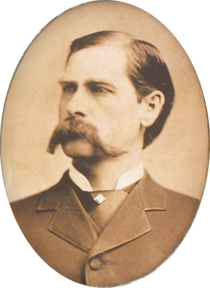 |
| Looks a bit like Kurt Russell, but it is Wyatt Earp |
Because Mann wasn't entirely happy with the script he had inherited he called in Borden Chase to do a re-write. Chase had written the screenplay for Mann's very first film, DR. BROADWAY (Paramount, 1942). His original Saturday Evening Post story had been the basis for Howard Hawks' famous Western, RED RIVER (Monterrey/UA, 1948). The story was nominated for an Oscar for best original story and he also co-wrote the screenplay. He would later write screenplays for two other Mann-Stewart Westerns.
THE PLOT
HIGH-SPADE FRANKIE WILSON (Millard Mitchell): "We've hit a lot of towns, Lin. What makes you think he'll be here?"
LIN MCADAM (James Stewart): "He'll be here."
HIGH-SPADE: "We've been wrong before."
LIN: "He'll be here."
HIGH-SPADE (indicating the prize Winchester in a window): "On account of that?"
LIN: "If he isn't here already, that gun'll bring him."
Lin McAdam (James Stewart) and his partner High-Spade (Millard Mitchell) ride into Dodge City Kansas on July 4, 1876, searching for Dutch Henry Brown, the man who murdered McAdam's father.
It is the year that Wild Bill was killed in Deadwood, Mark Twain published The Adventures of Tom Sawyer, Custer bought the farm on the Little Bighorn, and the Republicans stole a presidential election. But when McAdam and High-Spade ride into town there is an air of excitement and anticipation about a shooting contest in honor of the fact that it is also the centennial of America's Declaration of Independence. At stake is a "One of a Thousand" Winchester 1873 model rifle that will go to the winner. Marshal Earp is in charge of officiating at the contest.
WYATT EARP (Will Geer): "It seems as when the Winchester people are turning out these here guns, every so often, maybe one gun out of every ten or twenty thousand -- well, it comes out just perfect. Now naturally, it ain't for sale. I would give a year's wages for that gun, but money won't buy it. It wouldn't be right to sell it. So the Winchester people have given it a name. They call it "One of a Thousand."
As it turns out, McAdam is right. Dutch Henry Brown (Stephen McNally) and his two partners in crime, Wesley (Steve Brodie) and Wheeler (James Millican), are in town. There is no showdown in Dodge City between the two factions because the town's ordinance enforced by the Earps forces everyone to check their weapons when they enter town. However, a confrontation does develop when both McAdam and Dutch Henry enter the shooting contest.
 |
| Lin McAdam (Stewart) and Dutch Henry (McNally) are the two finalists in the shooting contest. The man on the right is Edmund Cobb, who appeared in hundreds of films, most of them Westerns. |
The rifle passes from Dutch Henry to a crooked Indian trader (John McIntire) to an Indian warrior (Rock Hudson) to a man of questionable courage (Charles Drake) to an outlaw (Dan Duryea), back to Dutch Henry and, finally, McAdam regains the rifle in a climatic shoot-out with Dutch Henry.
 |
| Lin McAdam (James Stewart) pursues Dutch Henry (Stephen McNally). The pursuit began in Tascosa, Texas. It must have been a long chase, because it appears they are now in Arizona! |
 |
| Lin McAdam, upper left, in pursuit of Dutch Henry, lower right. |
HIGH-SPADE (Millard Mitchell): "Well, that's the way it was. The old man sired two sons. One was no good...never any good. Robbed a bank...a stagecoach. Then when he came home and wanted to hide out, the old man wouldn't go for it. So Dutch Henry shot him...in the back."
Yes, Dutch Henry was really Matthew McAdam. And now you know why Lin McAdam was on his trail.
HIGH-SPADE (Millard Mitchell): "Did you ever wonder what he'd think about you hunting down Dutch Henry?"
LIN MCADAM (James Stewart): "He'd understand. He taught me to hunt."
HIGH-SPADE: "Not men. Hunting for food, that's all right. Hunting a man to kill him? You're beginning to like it."
LIN: "That's where you're wrong. I don't like it. Some things a man has to do, so he does 'em."
That's right. A man's gotta do what a man's gotta do.
I like this film. I really do. But I have one misgiving about it. No, make that two, both concerning Dan Duryea.
First, I never thought Duryea was a believable westerner. Furthermore, he was always way over the top and chewed up all the scenery in sight -- and never was that more apparent than in this film.
Second, Duryea portrays an outlaw named Waco Johnny Dean, who is not only crazy, but rather stupid as well. He makes his first appearance on screen when he and two of his gunmen who are being chased by a posse take refuge in a ranch house. It is night. The members of the posse hide in the dark behind fences and inside sheds. So, what is the first thing that the outlaws should have done when they entered the house, knowing there was a posse out there in the dark? That's right; they should have doused all the lights in the house! But they didn't.
Not only that, they shoot with their heads exposed in the windows. Waco Johnny and the other people stroll around the room as though there is no danger lurking outside. Nobody cowers in a corner or hides in another room. They all gather in the room with all the light, where the outlaws should have been easy targets for the posse hiding in the dark. But nobody gets killed inside the house. The outlaws are flushed from the house only after the posse uses the tried and true trick of crashing a wagon full of burning straw into the side of the house. That wasn't necessary. The outlaws were sitting ducks and one-by-one could have been picked off.
I cannot fathom why a careful film maker like Mann, one who was very conscious of authenticity, could have filmed such a scene. On the other hand, I have never read anything by anyone who has ever made mention of this scene.
THE SUPPORTING CAST
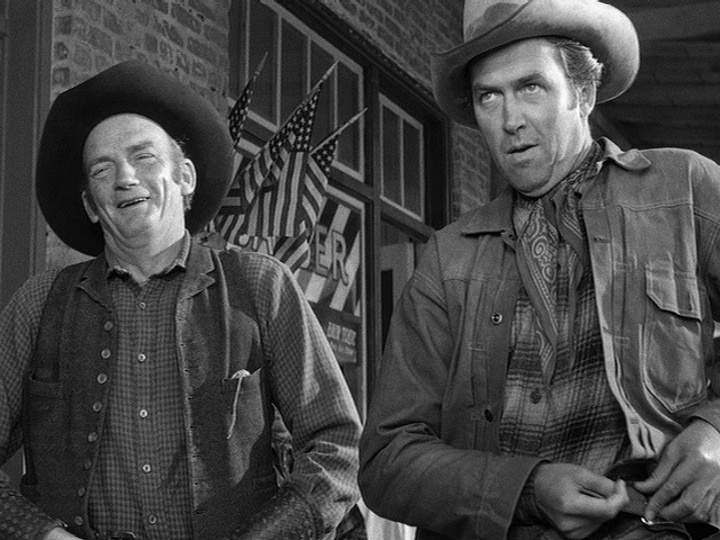 |
| Millard Mitchell, who died far too young, never gave a bad performance. |
 | ||
| Four Badmen (L-R): John McIntire, Steve Brodie, James Millican, Stephen McNally |
 |
| Waco Johnny Dean and Dutch Henry Brown |
 |
| Shelley Winters did her best, but there wasn't much she could do with her role as dance hall girl Lola Manners. A year later she would come into her own in A PLACE IN THE SUN (Paramount, 1951). |
 |
| Grizzled Jay C. Flippen, always a welcome presence in any Western |
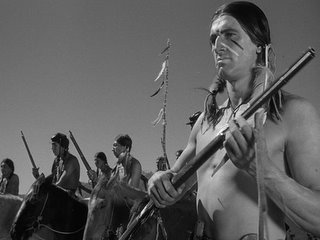 |
| Young, unknown Rock Hudson as Young Bull holding "the rifle" |
 | ||
| Two other young unknown actors: Tony Curtis and James Best |
THE CINEMATOGRAPHER
Anthony Mann was a director who loved to shoot on location. Most of his Westerns are greatly enhanced by his staging of scenes that take advantage of spectacularly rugged landscapes. In WINCHESTER '73, his efforts are perfectly complemented by the expertise of cinematographer William Daniels, a master of black & white photography. He was once Greta Garbo's favorite movie photographer, shooting twenty-one films starring the actress, but here he proved that he could film outdoor vistas with great style.
THE CRITICS
"Strikingly photographed in black & white, the film is directed with an eye to realistic detail, an ear for the script's frequently natural dialogue and a knack for building suspense." -- Time
"Stewart in career doldrums, made a comeback in two Westerns that were filmed back-to-back: this one and BROKEN ARROW. Although BROKEN ARROW was the bigger of the two...and received more attention because of its theme, WINCHESTER '73 is the superior film." Brian Garfield, Western Films: A Complete Guide
"Exceptional Western story....First-rate in every way....Beautifully photographed by William Daniels. -- Leonard Maltin
One critic just didn't get it:
"It's just a frisky, fast-moving, funny Western in which a rifle is the apple of a cowboy's eye." -- Bosley Crowther, New York Times