
He was born Frederick Dilley Glidden in Kewanee, Illinois. He wrote more than fifty novels and twice as many short stories. His books have sold thirty million copies – and are still selling almost forty years after his death. We know him by his pen name, Luke Short.
In 1930, he graduated with a journalism degree from the
University of Missouri and embarked on a career as a newspaper reporter – and
then disembarked. He couldn’t hold a
job. He was quoted as saying, “I’ve read
or heard that all newspapermen are disappointed writers, but in me you behold a
writer who is a disappointed newspaperman.
I’ve been fired from more newspapers than I like to remember, even if I
could.” He was only half-kidding; he
worked for five different newspapers in 1930-31.
A string of non-newspaper jobs followed, including logger
and fur trapper in Canada and archaeologist assistant in New Mexico. In his spare time, he read Western fiction in
the numerous pulp magazines of the day and concluded that he could write as
well as what he was reading.
In 1935, he sold his first short story followed in the same
year by his first novel, The Feud at Single Shot. It was after the sale of the short
story, published under the name F.D. Glidden, that a publisher suggested that
he adopt a pen name, since his real name sounded phony. His agent suggested Luke Short. Apparently, though it is difficult to believe, neither he nor his agent was
aware that this was the name of an Old West gambler-gunman befriended by Wyatt
Earp and Doc Holliday.
Short encouraged his wife to take up the pen and she began
to write stories under the name Vic Elder, a name that had also been suggested
by his agent. He also talked his brother
Jonathan into trying his hand at writing.
Jonathan adopted the pen name Peter Dawson and enjoyed a successful
career as a Western novelist until it was cut short by his death in 1957 at age fifty-five. Apparently, the
brothers in their youth had been well taught by their mother, a high school
English teacher.
In the later years of his career, Short attempted to step
outside the Western genre, but his efforts were not well received by critics or
the reading public. However, once he hit
on a successful formula he rarely experimented with his Western novels. They may have been formulaic, but the best of
them were well-crafted stories that resonated with the fans of the genre. The readers seem to have been reassured by
the fact that the plots were predictable and that there were no great
surprises. It seemed much like a visit
with an old friend who had a few new stories to tell.
Short readily admitted that he was influenced by the work of
Ernest Haycox. That influence can be
detected in the plotting of his stories and in the character development of the
heroes, who tended to be strong men who were slow to talk but quick to
act. Both writers nearly always included
two women in the plot, one good and one bad (or perhaps ‘less good’ or
misguided) and the hero invariably made the wrong choice initially, but before
the end of the story he was able to correct his error.
It is in the development of the female characters, however,
that Short surpassed Haycox. His women
were strong, independent, and believable characters and that was not always the
case with Haycox’s heroines, who tended to be more one-dimensional.
The ‘40’s were Short’s peak years as a writer. Not only did his novels sell well, but many of
them became the basis for films. In
1947-54, ten of his novels were adapted for the screen. The first was an underrated little classic, RAMROD
(UA, 1947). The next year four
of his novels were filmed with somewhat mixed results. However, two of them – CORONER CREEK (Columbia) and
BLOOD
ON THE MOON (RKO) -- were excellent.
In addition to his novels, his original story became the basis for THE
HANGMAN (Paramount, 1959).
The 50’s and 60’s were disappointing years for Short. He did not change, but apparently, the public
did. He continued to produce Western
novels that utilized the formula that had been so successful for him in the ‘40’s,
but did not sell nearly as well in the next two decades. As mentioned earlier, he did try his hand
outside the Western genre, but without much success.
Short moved from Santa Fe to Aspen, Colorado in 1947 and he
died there in 1975. For much of his career
he was deservedly known as “the dean of living Western writers.”
LUKE SHORT AND
HOLLYWOOD.
The following films were based on Luke Short novels -- and one original story:


Director: Andre deToth; Producer: Harry Sherman; Writers: screenplay by Jack Moffitt, C. Graham Baker and Cecile Kramer based on Luke Short novel of same name; Cinematographer: Russell Harlan
Starring: Joel McCrea and Veronica Lake
The plots of many of Luke Short's best novels involve range land conflicts in cattle country. Ramrod was one of his best and the film represents the best efforts of deToth, Sherman, and McCrea. Lake is not known for Western roles, but she was surprisingly good in this one.
You can read my review of the film here. And Colin has a review of it over at Riding the High Country.
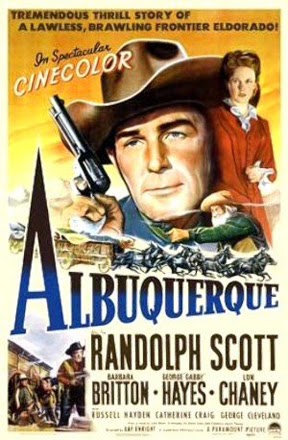
ALBUQUERQUE (Paramount, 1948)
Director: Ray Enright; Producers: William H. Pine and William C. Thomas; Writers: screenplay by Gene Lewis and Clarence Upson Young based on Luke Short novel, Dead Freight for Piute; Cinematographer: Fred Jackman, Jr.
Starring: Randolph Scott and Barbara Britton
The team of Scott and Enright had done good work before this film and would do even better the following year.
"It might be remarked in passing that the picture is neither especially good nor bad, as Westerns go; that Randolph Scott ... seems well able to take care of himself in the clinches .... And, yes, there is some shooting and a runaway stage to liven up the proceedings. But even that doesn't help much." -- The New York Times

Director: Ray Enright; Producers: William H. Pine and William C. Thomas; Writers: screenplay by Gene Lewis and Clarence Upson Young based on Luke Short novel, Dead Freight for Piute; Cinematographer: Fred Jackman, Jr.
Starring: Randolph Scott and Barbara Britton
The team of Scott and Enright had done good work before this film and would do even better the following year.
"It might be remarked in passing that the picture is neither especially good nor bad, as Westerns go; that Randolph Scott ... seems well able to take care of himself in the clinches .... And, yes, there is some shooting and a runaway stage to liven up the proceedings. But even that doesn't help much." -- The New York Times

CORONER CREEK (Columbia, 1948)
Director: Ray Enright; Producer: Harry Joe Brown; Writers: screenplay by Kenneth Gamet based on Luke Short novel of same name; Cinematographer: Fred Jackman, Jr.
Starring: Randolph Scott, Marguerite Chapman, and Forest Tucker
Scott and Tucker engage in two brutal fights. One is depicted in the upper right corner of the above poster.
"Solid little Western; Scott's fisticuffs with henchman Tucker are a highlight." -- Leonard Maltin

Director: Ray Enright; Producer: Harry Joe Brown; Writers: screenplay by Kenneth Gamet based on Luke Short novel of same name; Cinematographer: Fred Jackman, Jr.
Starring: Randolph Scott, Marguerite Chapman, and Forest Tucker
Scott and Tucker engage in two brutal fights. One is depicted in the upper right corner of the above poster.
"Solid little Western; Scott's fisticuffs with henchman Tucker are a highlight." -- Leonard Maltin
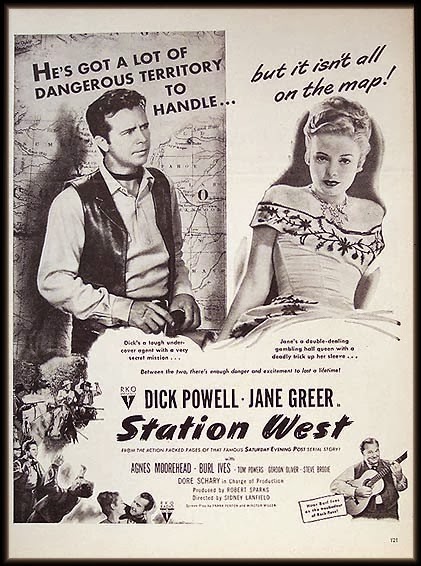
STATION WEST (RKO, 1948)
Director: Sidney Lanfield; Producer: Robert Sparks; Writers: screenplay by Frank Fenton and Winston Miller based on Luke Short novel of same name; Cinematographer: Harry J. Wild
Starring: Dick Powell and Jane Greer
This was Powell's only true Western role. Perhaps it is a case of lowered expectations, but he was far better and much more believable than anyone had any right to expect.
Colin at Riding the High Country has a review of this unique Western.


BLOOD ON THE MOON (RKO, 1948)
Director: Robert Wise; Producer: Theron Warth; Writers: screenplay by Lillie Hayward; adaptation by Luke Short and Harold Shumate based on Luke Short novel, Gunman's Chance, later re-issued as Blood on the Moon; Cinematographer: Nicholas Musuraca
Starring: Robert Mitchum, Barbara Bel Geddes, and Robert Preston
"BLOOD ON THE MOON is a terse, tightly-drawn Western drama. There's none of the formula approach to its story telling. Picture captures the crisp style used by Luke Short in writing his Western novels." -- Variety
You can read my review of the film here.

AMBUSH (MGM, 1950)
Director: Sam Wood; Producers: Armand Deutsch and Sam Wood; Writers: screenplay by Marguerite Roberts based on Luke Short novel of same name; Cinematographer: Harold Lipstein
Starring: Robert Taylor, John Hodiak, and Arlene Dahl
The poorly cast film is notable only for being the last film for director Wood.
"...the action, though fast towards the finish, is decidedly meager in this film, and Mr. Taylor is a flattire as a hero [Ouch!]." -- Bosley Crowther in The New York Times


VENGEANCE VALLEY (MGM, 1951)
Director: Richard Thorpe; Producer: Nicholas Nayfack; Writers: screenplay by Irving Ravetch based on Luke Short novel of same name; Cinematographer: George J. Folsey
Starring: Burt Lancaster, Robert Walker, and Joanne Dru
"This wasn't the best of the Luke Short novels and it's not the best of the movies made from his books, but it's not bad, though it's more soap than horse opera." -- Brian Garfield in Western Movies: A Complete Guide


SILVER CITY (Paramount, 1951)
Director: Bryan Haskin; Producer: Nat Holt; Writers: screenplay by Frank Gruber based on Luke Short novel, High Vermillion; Cinematographer: Ray Rennahan
Starring: Edmond O'Brien, Yvonne De Carlo, and Barry Fitzgerald


RIDE THE MAN DOWN (Republic, 1952)
Director: Joseph Kane; Producer: Joseph Kane; Writers: screenplay by Mary C. McCall, Jr. based on Luke Short novel of same name; Cinematographer: Jack A. Marta
Starring: Rod Cameron, Brian Donlevy, and Ella Raines
"McCall's screenplay is a perfect distillation of the flavor and complication of the novel. Kane's direction is swift and sure. The music is unobtrusive but proper, and the photography is thoroughly craftsmanlike." -- Brian Garfield in Western Movies: A Complete Guide

Hell's Outpost (Republic, 1954)
Director: Joseph Kane; Producer: Joseph Kane; Writers: screenplay by Kenneth Gamet based on Luke Short novel, Silver Rock; Cinematographer: Jack A. Marta
Starring: Rod Cameron and Joan Leslie
This is a modern day mining story capably handled by all concerned.

Director: Sidney Lanfield; Producer: Robert Sparks; Writers: screenplay by Frank Fenton and Winston Miller based on Luke Short novel of same name; Cinematographer: Harry J. Wild
Starring: Dick Powell and Jane Greer
This was Powell's only true Western role. Perhaps it is a case of lowered expectations, but he was far better and much more believable than anyone had any right to expect.
Colin at Riding the High Country has a review of this unique Western.


BLOOD ON THE MOON (RKO, 1948)
Director: Robert Wise; Producer: Theron Warth; Writers: screenplay by Lillie Hayward; adaptation by Luke Short and Harold Shumate based on Luke Short novel, Gunman's Chance, later re-issued as Blood on the Moon; Cinematographer: Nicholas Musuraca
Starring: Robert Mitchum, Barbara Bel Geddes, and Robert Preston
"BLOOD ON THE MOON is a terse, tightly-drawn Western drama. There's none of the formula approach to its story telling. Picture captures the crisp style used by Luke Short in writing his Western novels." -- Variety
You can read my review of the film here.

Director: Sam Wood; Producers: Armand Deutsch and Sam Wood; Writers: screenplay by Marguerite Roberts based on Luke Short novel of same name; Cinematographer: Harold Lipstein
Starring: Robert Taylor, John Hodiak, and Arlene Dahl
The poorly cast film is notable only for being the last film for director Wood.
"...the action, though fast towards the finish, is decidedly meager in this film, and Mr. Taylor is a flattire as a hero [Ouch!]." -- Bosley Crowther in The New York Times


VENGEANCE VALLEY (MGM, 1951)
Director: Richard Thorpe; Producer: Nicholas Nayfack; Writers: screenplay by Irving Ravetch based on Luke Short novel of same name; Cinematographer: George J. Folsey
Starring: Burt Lancaster, Robert Walker, and Joanne Dru
"This wasn't the best of the Luke Short novels and it's not the best of the movies made from his books, but it's not bad, though it's more soap than horse opera." -- Brian Garfield in Western Movies: A Complete Guide


SILVER CITY (Paramount, 1951)
Director: Bryan Haskin; Producer: Nat Holt; Writers: screenplay by Frank Gruber based on Luke Short novel, High Vermillion; Cinematographer: Ray Rennahan
Starring: Edmond O'Brien, Yvonne De Carlo, and Barry Fitzgerald
This is undoubtedly the weakest of all the films based on a Luke Short story. It is poorly cast, weakly acted, ineptly directed, and Gruber's screenplay took all the flavor out of Short's novel. I have tried -- really tried -- but I have never been able to sit all the way through it. The only good thing that I can say about what I have seen is that Rennahan, as usual, did a superb job of photographing the film.

RIDE THE MAN DOWN (Republic, 1952)
Director: Joseph Kane; Producer: Joseph Kane; Writers: screenplay by Mary C. McCall, Jr. based on Luke Short novel of same name; Cinematographer: Jack A. Marta
Starring: Rod Cameron, Brian Donlevy, and Ella Raines
"McCall's screenplay is a perfect distillation of the flavor and complication of the novel. Kane's direction is swift and sure. The music is unobtrusive but proper, and the photography is thoroughly craftsmanlike." -- Brian Garfield in Western Movies: A Complete Guide

Hell's Outpost (Republic, 1954)
Director: Joseph Kane; Producer: Joseph Kane; Writers: screenplay by Kenneth Gamet based on Luke Short novel, Silver Rock; Cinematographer: Jack A. Marta
Starring: Rod Cameron and Joan Leslie
This is a modern day mining story capably handled by all concerned.

The Hangman (Paramount, 1959)
Director: Michael Curtiz; Producer: Frank Freeman, Jr.; Writers: screenplay by Dudley Nichols based on story by Luke Short; Cinematograper: Loyal Griggs
Starring: Robert Taylor and Tina Louise
The film has a decent cast and Dudley Nichols was an accomplished screenwriter, but Michael Curtiz's direction of Western films always left much to be desired.
Director: Michael Curtiz; Producer: Frank Freeman, Jr.; Writers: screenplay by Dudley Nichols based on story by Luke Short; Cinematograper: Loyal Griggs
Starring: Robert Taylor and Tina Louise
The film has a decent cast and Dudley Nichols was an accomplished screenwriter, but Michael Curtiz's direction of Western films always left much to be desired.


