THE AMERICAN WEST (mostly): Fact and Fiction (mostly fiction)


"NOBODY GETS TO BE A COWBOY FOREVER." -- Chet Rollins (Jack Palance) in MONTE WALSH (NG, 1970)

Total Pageviews

Sunday, September 27, 2015

THE BRAVADOS (Fox, 1958)


DIRECTOR: Henry King;  PRODUCER: Herbert B. Swope, Jr.; WRITERS: screenplay by Phillip Yordan based on novel by Frank O'Rourke; CINEMATOGRAPHER: Leon Shamroy


CAST: Gregory Peck, Joan Collins, Stephen Boyd, Albert Salmi, Henry Silva, Kathleen Gallant, Barry Coe, George Voskovec, Herbert Rudley, Lee Van Cleef, Andrew Duggan, Ken Scott, Gene Evans, Joe De Rita


THE PLOT.
Frankly, this movie could have and should have been better. After all, it had an accomplished director at the helm, starred one of the best actors to appear in Western films, featured outstanding location photography, a stirring musical score, an interesting supporting cast, and a talented actress -- no, wait -- I went too far.  Erase that last part.  That was part of the problem.

Perhaps part of the fault also lies in Yordan's screenplay or O'Rourke's novel, but something is missing.  Despite its component parts, the sum of which are greater than the whole, it is not a classic film, perhaps not even a great one, but it isn't a bad one either.

Jim Douglas (Gregory Peck) has been on a mission. For some time he has been searching for four men that he believes raped and murdered his wife.  They have been described as two white men (Stephen Boyd and Albert Salmi), a "half-breed" (Lee Van Cleef), and an Indian (Henry Sliva).  Now he learns that the four are locked up in the jail in the border town of Rio Arriba, sentenced to hang for attempted bank robbery and the killing of a teller.

Douglas rides into the village because he wants to look the killers in the eye and to witness their hanging the next day.  However, that evening, while most of the community is in church, the outlaws break jail, abducting a merchant's daughter, Emma Steinmetz (Kathleen Gallant), while making their getaway.

Stephen Boyd and Albert Salmi above and Lee Van Cleef and Henry Sliva below are the four "bravados"


Since the sheriff (Herbert Rudley) is seriously wounded during the jail break, a posse is formed and led by his deputy, Primo (Ken Scott).  Primo and the other posse members defer to Douglas as the manhunt begins.

Douglas taking the lead is successful in tracking down the fugitives one by one. Each time he shows them a picture of his deceased wife and small daughter and asks them if they have ever seen them before.  Each man swears that he hasn't, but Douglas doesn't believe them and kills the first two (Van Cleef and Salmi) in a coldblooded fashion. After Emma is found, alive but having been raped by Zachary (Boyd), Douglas tracks him down and kills him in a shootout in a Mexican cantina.
After trailing Lujan (Silva) to his home in the mountains, Douglas learns that he has been wrong about some things -- some rather important things.  After Lujan's wife subdues Douglas by conking him on the head with a pot and Lujan has a gun on him, Douglas shows Lujan the picture and, like the other three men, Lujan claims he has never seen the woman or the child.  Eventually, Lujan persuades Douglas that neither he nor the other three had anything to do with his wife's death. The realization leaves him speechless with remorse.

Nevertheless, when he returns to Rio Arriba he is greeted as a hero by the community.  It is grateful to him for what he has done.  After all, the four men had attempted to rob the bank and had killed one of the town's citizens. When the assembled townspeople offer their gratitude, Douglas asks for their prayers.

Many, many times, before and after THE BRAVADOS, the vengeance plot has been adapted for the screen, sometimes featuring the hero tracking the killer or killers of his brother or maybe his father.  In numerous films, B-Western star Bob Steele found himself searching for the mangy coyote who killed his father. In fact, it happened so often that "the Bob Steele plot" became shorthand for such a story (One reason it may have been so prevalent in the Steele films is that many of them were written and directed by his real-life father.)

But in other films, as in THE BRAVADOS, the avenger was searching for his wife's murderer(s).  An excellent example is SEVEN MEN FROM NOW (1956), the first of several classic collaborations by director Budd Boetticher and star Randolph Scott.  At least Peck's character only had to track down four men.


THE DIRECTOR.
Henry King (1915)
Henry King (1886-1982) was one of the most talented and certainly most versatile directors in Hollywood's history.  He was equally adept at directing musicals, melodramas, and epics. Unfortunately, that versatility resulted in him directing precious few Westerns for people like us. But he was good at that, too.  He never failed us the few times he was given the responsibility of filming one.

An actor in silent films, he began directing in 1915. During the silent era he directed a few Westerns, the most noteworthy being THE WINNING OF BARBARA WORTH (1928), a film that went a long way in launching the long successful career of a young actor named Gary Cooper.

His first Western during the sound era was a classic: JESSE JAMES (1939), starring Tyrone Power and Henry Fonda.  His second was also a classic: THE GUNFIGHTER (1950), starring Gregory Peck.  His only other Western was THE BRAVADOS, perhaps not a classic, but nevertheless a good one.  And that was it.  Just three Westerns during the sound era, but each is a winner.


THE CAST.
Completely out of character, Gregory Peck's first Western movie role found him portraying an unlikable, unreformed scoundrel in the overblown epic, DUEL IN THE SUN (1947).  But things quickly took a turn for the better a year later when he gave an outstanding performance as a bad man who does reform in YELLOW SKY (1948).  He was even better in THE GUNFIGHTER, which as noted earlier, was Henry King's second sound Western, and was one of Peck's greatest performances.    

The '50's, the best decade ever for Westerns, was a great one for Peck, with THE BRAVADOS being bookended by THE GUNFIGHTER and THE BIG COUNTRY (1959).

Joan Collins appeared in only three Western features -- or maybe only one depending on what one considers to be a Western.  One was a comedy spoof, one was a Northerner set in the Yukon during its gold rush, and the other is THE BRAVADOS.  Collins looks uncomfortable in the film, especially when she is astride a horse, and there seems to be absolutely no chemistry between the two stars.  Peck does often seem ill at ease in romantic scenes, but with the right actress he comes across as believable, even in Westerns.  For proof see his scenes with Jennifer Jones in DUEL IN THE SUN or Anne Baxter in YELLOW SKY


The production does have an international flavor.  It was filmed on location in Mexico (before that became common); Joan Collins was born in London; and though Albert Salmi was born in Brooklyn, his parents were Finnish immigrants; and Stephen Boyd was a native of Northern Ireland.  

In 1956, Boyd signed a seven year contract with Twentieth Century-Fox, but is best known for his role as Messala in BEN HUR (1959), while on loan-out to MGM.  He appeared in only three Westerns, with THE BRAVADOS being the best by far.  The others were SHALAKO (1958) and HANNIE CAULDER (1972).  He was only in his mid-forties when he died in 1977.

Albert Salmi began his acting career on the stage.  One of his early roles was in the Broadway production of The Rainmaker. In 1955, he was cast as rodeo cowboy Bo Decker in Bus Stop. As a result of the critical praise he received, he was offered the role for the movie version with Marilyn Monroe.  He turned it down because he preferred the stage over movies.  Another notable performance came in 1953 on the TV anthology series, The U.S. Steel Hour, when he portrayed a major league catcher with a terminal illness in the dramatization of Mark Harris' novel, Bang the Drum Slowly.  A young actor by the name of Robert De Niro played the part in the movie version.


Paul Newman as pitcher Henry "Author" Wiggen and Albert Salmi as catcher Bruce Pearson in the U.S. STEEL HOUR production of BANG THE DRUM SLOWLY (1953) 

THE BRAVADOS was Salmi's second movie role and his first in a Western. Through the years the busy character actor would appear in several more, perhaps the most notable being THE UNFORGIVEN (1960) and HOUR OF THE GUN (1967).  He seemed to enjoy his Western roles and became a ubiquitous and welcome presence in TV Westerns during their heyday.

He was still acting right up until his death in 1990, which occurred under tragic circumstances.  It was ruled that he shot and killed his estranged wife before committing suicide.

Henry Silva, like Salmi, born in Brooklyn and in the same year (1928), gives one of his better performances as the Indian Lujan.  He did not appear in a lot of Westerns, but was rather impressive as one of Richard Boone's henchman, a cold-blooded killer, in the Boetticher-Scott film, THE TALL T (1957).

Clarence Leroy Van Cleef, Jr. was born in New Jersey in 1925.  It is quite ironic that both Van Cleef and Jack Elam were accountants before launching careers as two of the most recognizable and despicable villains to appear on the screen.  In the end, however, Elam became a latter-day comic actor in the tradition of Walter Brennan and against all odds Van Cleef became a star.  

Van Cleef broke into movies as the result of producer-director Stanley Kramer spotting him in a touring company of the play, Mister Roberts.  Kramer wanted to cast the young actor as Deputy Harvey Pell in HIGH NOON (1952).   However, Kramer did have one request.  He asked the young actor to have his hawk-like nose fixed.  To his credit, Van Cleef refused.  He was still cast in the film, but as one of the four gunmen who stalk Marshal Will Kane (Gary Cooper) in the streets of Hadleyville.  Lloyd Bridges was chosen to portray the deputy.

The year after THE BRAVADOS, Van Cleef headed the gang of outlaws who pursued Randolph Scott in the Boetticher-Scott film, RIDE LONESOME, and in 1962 he was one of Liberty Valance's (Lee Marvin) henchmen in THE MAN WHO SHOT LIBERTY VALANCE.  During these years he also appeared on virtually every TV Western series in production, even those aimed at juvenile audiences.

Then in 1965, Sergio Leone cast him in support of a fellow named Eastwood in FOR A FEW DOLLARS MORE and an international star was born.  It wouldn't be correct to call him a hero in the spaghetti Westerns that followed, because there was no such character in any of those films.  But like Eastwood before him, he became an antihero.   


******
REVIEWS.
"It's a grim, hard, pursuit drama, brutal at times, with a pointed messge about the futility of revenge.  Tough and tight, it has a big look and a heroic stirring score; the acting is very good.  There are moments when one must wince -- the lame tip of the hat to religious faith; the turgid romantic interludes; a tailored and curiously Tom Mix-ish costume worn by the hero -- but Henry King...always seemed capable of eliciting [Peck's] best performances.  This one is a superior and often quite moving Western." -- Brian Garfield, Western Film: A Complete Guide

"Distilled to essentials, THE BRAVADOS is, simply, a manhunt.  But it is executed intelligently in fine, brooding style against eye-filling, authentic backgrounds, so that its basically familiar ingredients glisten with professional polish." -- A.H. Wieler, New York Times

Now for an opposing viewpoint:

"A routine, would-be prestige Western....both King's direction and Peck's acting lack the intensity needed to animate it." -- Phil Hardy, The Western 


Sunday, September 6, 2015

QUICK HITS III

Here are some quick looks at a few more books that I have given a rating of 5 out of a possible 5 stars.  All deal with the world of sports.  Two are novels about professional boxing while all the others are nonfictional looks at professional baseball.


THE PROFESSIONAL by W.C. Heinz (originally published in 1958)

This debut novel by notable sports journalist W.C. Heinz is the story of the quest of a boxer to become the middleweight champion.

Here are what some other writers thought about the book:

"....one of five best sports novels ever written." -- Pete Hamill   

"....the only good novel I've ever read about a fighter." -- Ernest Hemingway

"The way I remember it, I read The Professional when it came out in January 1958, and for the first and only time in my life wrote to the author to tell him how much I liked his book." -- Elmore Leonard

And finally this:

"Heinz is not just one of the great sportswriters this country has produced, he is one of the great American writers." -- Mike Lupica


THE KILLINGS OF STANLEY KETCHEL by James Carlos Blake (published in 2006)


Stanley Ketchel
"The short brutish life of Stanley Ketchel, the middleweight champion of the ragtime era who ruled the ring until his murder at age 24, serves as inspiration for Blake's action-packed novel....From Gibson Girl Evelyn Nesbitt, who enjoys a passionate liaison with Ketchel, to Emmett Dalton, last of the old-time outlaws, Blake brings to life a huge cast of characters across a glittering, vital America. -- Publishers Weekly

Yes, Blake's book is a novel, but it is based on the life of a fighter that many experts believe to be the greatest middleweight champion in history.

He won forty-nine of his sixty-four fights by knockout and lost only four.  A handsome, dapper, lady's man, he was murdered in 1910. 


STEINBRENNER: THE LAST LION OF BASEBALL by Bill Madden (published in 2010)


Bill Madden is a veteran baseball writer who has covered the New York Yankees for the New York Daily News for many years.  He has been there for many of the ups and downs in the life and times of George Steinbrenner and his team. 

Love him or hate him (being a lifelong Cardinals fan, I confess to being in the latter camp), it is impossible to argue with the man's success as the owner of the New York Yankees -- or is it?  Well, the team did win seven World Series during his stewardship, but Michael Shapiro argues in his review of the book that those victories were not always the result of his actions -- but sometimes in spite of them.  

Shapiro goes on to say that if Steinbrenner "had limited his involvement to writing checks, there is every reason to believe the Yankees might have fared better."  In the end, he says, Madden's book is "a devastating account."

At the time of the book's publication, Steinbrenner, at age seventy-nine, was retired and in bad health. He died later that year.


SEASONS IN HELL: WITH BILLY MARTIN, WHITEY HERZOG AND "THE WORST BASEBALL TEAM IN HISTORY" -- THE 1973-1975 TEXAS RANGERS by Mike Shropshire (originally published in 2005)


Billy Martin makes his point with the man in blue


Mike Shropshire, who covered the Rangers for the Fort Worth Star-Telegram, wrote a humorous, irreverent, politically incorrect, funny book about that team and its cast of characters. If Hunter Thompson had written a "Ball Four" book about the Texas Rangers this would have been the book.

Here is a sample:

"Even before the start of spring training, Herzog had said, 'If Rich Billings is the starting catcher again, we're in deep trouble.' When that evaluation was passed along to Billings, he simply nodded and said, 'Whitey, obviously, has seen me play.'"

If one reads the reader reviews on the Amazon website, one will find that Texas Rangers fans hate the book and everybody else loves it. I'm not a Texas Rangers fan.


THE LAST REAL SEASON: A HILARIOUS LOOK BACK AT 1975 -- WHEN MAJOR LEAGUERS MADE PEANUTS, THE UMPIRES WORE RED, AND BILLY MARTIN TERRORIZED EVERYONE by Mike Shropshire (originally published in 2008)


This is Shropshire's sequel to the above book.  It is a humorous, irreverent, politically incorrect, inside view of the 1975 baseball season, starring Billy Martin and the hapless Texas Rangers, a team that began the season with playoff aspirations. Unfortunately, it didn't happen and the Rangers had to wait another twenty-one years before it would happen.

Shropshire had the job of covering the Rangers when they were one of the most incompetent teams in the major leagues. He was able to survive with the aid of certain mood enhancers and a sense of humor.

If you are a baseball fan and old enough to remember the escapades and exploits of Alfred Manuel "Billy" Martin, I think you will really enjoy The Last Real Season. If not, you might still enjoy it; but maybe not if you are a Rangers fan.


CULT BASEBALL HEROES: THE GREATS, THE FLAKES, THE WEIRD AND THE WONDERFUL -- edited by Danny Peary (originally published in 1990)


This is an anthology of essays written about fifty-nine baseball players -- the greats, the flakes, the weird and the wonderful -- by a varied collection of writers.  As Peary writes in the introduction, the essays "were written by sports columnists from around the country, broadcasters, and former players, as well as actors, directors, and an assortment of writers who have a deep love of baseball."

My personal favorite among the essays is the very first one. Film director Ron Shelton writes about minor-league phenom Steve Dalkowski, whose fastball even scared Ted Williams -- yes, that Ted Williams!  

You probably never heard of Dalkowski because he was so wild that he never made it to the major leagues.  But could he ever throw hard!  He once hit an umpire with a wild pitch and broke his mask in three places.  An attempt was made to measure the speed of his fastball with a primitive radar gun, but it took him almost an hour to hit the target.  Due to the fact that he had made so many pitches and consequently had lost so much off his fastball the measurement when he finally did hit the target was meaningless. The actual speed of his legendary fastball remains a mystery.


Wednesday, August 19, 2015

LET US NOW PRAISE FAMOUS MEN by James Agee and Walker Evans


Let Us Now Praise Famous Men became an overnight classic twenty-five years after Agee was given an assignment to write an article for Fortune magazine in 1936, which the magazine subsequently rejected and never published; twenty years after it was finally published as a book; and five years after its author succumbed to a heart attack in a New York taxi on his way to a doctor's appointment.

Agee was just twenty-six, a poet in the guise of a journalist, when he was given the assignment to travel into the Deep South to do a story on cotton sharecroppers. He asked that a friend of his, thirty-two year old photographer Walker Evans, be hired to accompany him. Evans at the time was working for one of the New Deal agencies, the Farm Security Administration, helping to document the Great Depression. Evans was given a leave of absence and he and Agee headed South during the summer of 1936.

They traveled around for a month before they found the subjects they wanted to photograph and write about. They spent three weeks with three families and then went back to New York to finalize the article and present it to the magazine's editor. The magazine did not publish it. It was believed for many years that Agee's unconventional rambling style was the cause for the editor's rejection of the article. However, decades later it was discovered that that was not the case.


"Isn't every human being both a scientist and an artist; and in writing of human experience, isn't a good deal to be said for recognizing that fact and for using both methods?"


At any rate, after the article was rejected, Agee then expanded it into a book and set about to find a publisher. It was five years later that it was published to a resounding sound of silence. It was a miserable failure, partly because the effects of the Great Depression had lessened and because the war in Europe and Asia dominated the news. The book sold only 600 copies the first year and there was no second printing -- not then.


"Picking cotton: it is simple and terrible work. Skill will help you; all the endurance you can draw up against it from the roots of your existence will be thoroughly used as fuel to it; but neither skill nor endurance can make it any easier."


"...and in each private and silent heart toward that climax of one more year's work which yields so little at best, and nothing so often, and worse to so many hundreds of thousands..."


Agee went on to other things; he continued to write poetry; became an influential and highly-respected film critic; and he wrote screenplays for two classic movies: THE AFRICAN QUEEN and THE NIGHT OF THE HUNTER.

But he was a tormented man who fought off his demons with tobacco and alcohol and the combination helped bring on the heart attack that killed him at age forty-five. At the time of his death he was working on an autobiographical novel. Two years after his death, A Death in the Family was published and a year later it received the Pulitzer Prize for fiction.

Two years after that, because of Agee's untimely death and as a result of the critical acclaim for his novel, Let Us Now Praise Famous Men was re-published and became an instant classic, not only due to Agee's narrative, but also because of Evans' haunting black-and-white photographs that appear uncaptioned at the beginning of the book.

In 2003, a typescript of Agee's original magazine article was discovered among his papers. It is much different from the book that grew out of the project. It is much more conventional, much more journalistic, and much less poetic. It had not been rejected due to an unconventional writing style after all, but for some other reason or reasons.

In 2013, it was published as Cotton Tenants: Three Families, the title of Agee's rejected magazine article.


******
The link will take you to Walker Evan's photographs:  https://www.google.com/search?q=let+u...


James Agee
Walker Evans


Tuesday, August 18, 2015

GUNSMOKE I

ANNOUNCER (George Walsh):  "Around Dodge City and in the territory on West -- there's just one way to handle the killers and the spoilers -- and that's with a U.S. marshal and the smell of gunsmoke.  'Gunsmoke' starring William Conrad. The story of the violence that moved West with young America -- and the story of a man who moved with it."

MATT DILLON (William Conrad): "I'm that man, Matt Dillon, United States Marshal -- the first man they look for and the last they want to meet.  It's a chancy job -- and it makes a man watchful -- and a little lonely."


No, the above is not a typo.  The original Matt Dillon was not James Arness, but another big man (though in a different way), William Conrad.  The program debuted on radio in 1952, three years before its inaugural TV season.  At the time there were those who said that they thought that the radio version was more realistic and therefore was superior to the TV series.  Whether that is true or not, there is no doubt that the radio version was one of the best produced, best written, and best acted programs to ever grace the radio airways.
  

The original Matt Dillon (1952)

Gunsmoke's radio cast
Early TV Western series used as their model the B-Western movies that had been so popular among juveniles -- especially male juveniles.  In fact, three of them starred the actors who had dominated B-Western movie production during most of the sound era: Hopalong Cassidy (William Boyd), Gene Autry, and Roy Rogers.  In addition, there was the Lone Ranger, who was originally a radio creation, but who easily made the transition to television.

Most radio Western series were cut out of the same cloth.  As mentioned, that's where the Lone Ranger began his adventures, soon to be joined by Boyd, Autry, Rogers, and others who geared their programs to the same youngsters who sat on the front row during Saturday matinees at the theater.

While it is also true that adults could find and enjoy Western movies at the theater that were aimed at grown-ups, that was not the case when it came to early TV or radio -- at least not until 1952.  However, that changed that year when Gunsmoke, the first "adult Western" to air on network radio, made its debut on CBS.

It is generally conceded that the first adult TV Western series did not appear until 1955 and therefore radio had a three year head start.  Ironically, it was the debut that year of a TV version of Gunsmoke that did more than any other program to trigger a veritable avalanche of adult Westerns that would swamp TV programming and dominate its ratings during the remainder of that decade.

Three years before the TV version's first season, however, one of the co-creators of the radio show, Norman Macdonnell (1916-1976), used the term "adult Western" in an interview describing his new program, and thus is thought to be the originator of the term.  Besides being a co-creator of the series, he also served as its producer and director.  His partner in the endeavor was writer John Meston (1914-1979). Each man was only in his thirties when the radio series was launched. 


Publicity still for Gunsmoke
MATT DILLON.
John Meston grew up in Pueblo, Colorado and had worked on cattle ranches and he had spent time listening to stories told by old-time cowboys.  As a result, he was able to bring an air of authenticity to the show's scripts.

Meston and Macdonnell wanted a hero, but one who was not invincible.  They wanted him to be more human than the B-Western heroes and thus more believable.  He wouldn't always be right or certain that he was doing the right thing.  As William Conrad said about his character: "Matt Dillon isn't perfect but he is willing to try."  In other words, he would not always be the "white-hatted" hero that juvenile audiences preferred.

And the villains he faced would not always be the outright evil scoundrels that the Lone Ranger or Hopalong Cassidy or Tom Mix opposed on the airways. There would be more gray and less black-and-white when it came to the motivations of the hero as well as of those that he attempted to bring to justice.

Although it is true that Macdonnell and Meston attempted to produce a realistic Western series and for the most part succeeded in their efforts, it did fall short in one respect.  Matt Dillon was a U.S. marshal.  He enforced the law -- federal, state, and local -- with only Chester, a part time deputy, and a none too bright one at that, to assist him.  Where the heck was the sheriff that the good people of Ford County elected to enforce state law -- not to mention his deputies?  And what about the town marshal who was hired by the town to enforce municipal ordinances -- not to mention his deputies?  The truth is there would have been not one, but three layers of law enforcement in and around Dodge City.  


Dodge's notorious Front Street
I know that Meston, a man who grew up in the West, and who read widely about the history of that region, knew better and that in other ways the program was historically accurate, but I have never understood why he did not make Matt a sheriff, or a town marshal, or at least give him some help.    

Well, now that's off my chest and we can proceed.

THE STAR.
Before Gunsmoke, Norman Macdonnell was the producer and director of Escape.  The narrator of that series was a radio actor who was not only blessed with a deep and resonant voice, but a voice that was also capable of expressing a wide range of emotions.  The actor was William Conrad (1920-1994) and he wanted the role of Matt Dillon.

At first Macdonnell was reluctant to cast Conrad as Matt Dillon.  It wasn't because he didn't think Conrad would be good in the role.  It was that he thought the actor, one of the most ubiquitous radio actors in the business and the possessor of such a distinctive voice, would be too familiar to radio audiences.  However, during Conrad's audition he became convinced that the actor would be a perfect Matt Dillon.  Macdonnell would later give Conrad much of the credit for how his character and the show evolved.

Although Conrad was not cast in the Matt Dillon role when the TV series was launched in 1955, he did eventually star in three non-Western TV series: Cannon (1971-1976); Nero Wolfe (1981); and Jake and the Fatman (1987-1992).  Even when he was not seen, his voice could be heard as the narrator of TV shows such as The Fugitive (1963-1967), The Bullwinkle Show (1959-1961), and many others.  


THE SUPPORTING CAST. 


Parley Baer  as Chester Proudfoot
Parley Baer (1914-2002) portrayed Chester, Matt's assistant and part time deputy.  He wasn't much of a lawman, but he was a loyal friend who always addressed the marshal as either Mr. Dillon or Marshal Dillon, but never Matt.

And at first he was only Chester, no last name.  But at a rehearsal Baer adlibbed the full name of the character as Chester Wesley Proudfoot, and the name stuck.  (On the TV series, because Chester was handicapped by a stiff leg, the last name was changed to Goode.)

An extremely busy actor, during his tenure on Gunsmoke, he moonlighted from 1953-1965 on television in a recurring role as the Nelson's neighbor Darby, on The Adventures of Ozzie and Harriet.  In 1962-1963, he was memorable as the prickly, persnickety, hot tempered, thorn-in-the-side, Mayor Roy Stoner on The Andy Griffith Show.

But that likes a lot of telling the whole story.  Baer enjoyed a sixty-four year career in radio, TV, and movies and was still working well into his eighties.

Howard McNear as Doc Adams
Howard McNear (1905-1969) was another busy radio actor who possessed a readily recognizable voice.  He portrayed Dodge City's only doctor, a man who was driven West by a weakness for alcohol, but one he was able to overcome.

When the Gunsmoke radio series ended its long run, McNear didn't miss a beat.  Like Parley Baer, he moved to TV and into his most famous role, that of Floyd Lawson, the lovable barber on The Andy Griffith Show.  Thus for one season, he and Parley Baer were reunited.

McNear's tenure on the show was interrupted during its third season when he suffered a severe stroke.  He returned after a year and half absence, but because of the paralysis that he continued to experience on one side, he was always photographed sitting, usually on a bench in the front of the barber shop. He left the show in 1967, and died two years later, due to complications from another stroke.

Georgia Ellis (1917-1988) portrayed Kitty Russell.  She was a saloon girl, and not, as in the TV series, the owner of a saloon or a "hostess," but simply a working girl, primarily at the Long Branch.  She was on the show to add a little romance in the life of Matt Dillon and to give him someone to pass time with other than Chester and Doc.

Of the four principals, her character was the least developed and, unlike the other stars, her career pretty well ended with this role.   

MUSIC AND SPECIAL EFFECTS.
Rex Koury composed a haunting, poignant, and strangely sad theme that was played at the beginning and the conclusion of each episode.  It fit the mood of the show perfectly.  He also wrote the interior music that was used to bridge scenes and heighten the sense of suspense.  The music added a great deal to the enjoyment of the show.

The theme also opened and closed each TV episode.  However, at some point a misguided decision was reached to use a more up tempo, more jazzed up version of the theme.  That was unfortunate, for it just did not have the same effect as the original.

Another great attribute of the program were the special effects. Even without dialogue the listener had a good idea of what was occurring just by the sound of footsteps on a wooden walk, horses and wagons passing on the street, dogs barking in the distance, and people talking in the background.  It truly became a "theater of the mind."

In 1955, three years after the debut of the radio show, Gunsmoke began a twenty year run on TV.  All four stars of the radio show were given auditions for the TV version.  But it was only a formality; none of them were given any serious consideration.  So they soldiered on as before, and one would hope that they were consoled by the fact that they were contributing to one of the greatest radio programs ever produced, one that lasted nine years and did not end until 1961.


Thursday, July 23, 2015

QUICK HITS II

The following are some quick looks at a few books dealing with war that I think deserve a 5 out of 5 rating:


WOE TO LIVE ON, Daniel Woodrell, (originally published in 1986)


This is early Woodrell and a departure from what would come later.  Woe To Live On is a work of fiction, but is nevertheless an accurate depiction of the dirty little guerrilla conflict fought in Missouri during the Civil War in which nobody won and everybody lost.  The title of the movie based on the book was RIDE WITH THE DEVIL (1999). 

Woodrell, who lives in the Missouri Ozarks, knows the history and the territory. Later he would become best known for stories and novels that he characterized as country noir.


THE YOUNG LIONS, Irwin Shaw, (originally published in 1948)

I had long believed that there were three great American World War II novels that shared the common characteristics of being written by veterans of that conflict and being published during its immediate aftermath.

They are: The Naked and the Dead (1948) by Norman Mailer; The Caine Mutiny (1951) by Herman Wouk; and From Here to Eternity (1951) by James Jones. But I need to add a fourth book that belongs in the same company: The Young Lions (l949) by Irwin Shaw, a book that was originally overshadowed by the others.

I first read The Young Lions about twenty-five years ago. Based on my memory I ranked it below the aforementioned books. However, as a result of my recent re-reading of the book, I see that it was better than I remembered.

With one exception, these novels are enriched by the fact that they are based upon the writers’ personal experiences during the war. The exception is The Naked and the Dead. Mailer did serve in the Pacific, but saw little combat and ended the war as a cook in the Philippines. There’s nothing wrong with that, of course, but it does mean that his classic story of a reconnaissance mission on a Pacific island was not based on his personal experience.

One of the ways that I judge my enjoyment of a book (or a movie) is whether or not I am willing to revisit it. Well, I have now read The Young Lions twice and the others three times each. Twenty-five years from now I plan to read Shaw’s book for a third time.


THE BIG WAR, Anton Myrer, (originally published in 1957)


 A reviewer for The Saturday Review made the claim that The Big War was "incomparably the finest novel to come out of World War II..." I don't quite agree with that evaluation (after all, I have read it only twice), but I do think it is a classic.  Like the finest novels dealing with that conflict, it was written by a veteran who was able to draw upon his personal experience.

The film adaptation is titled IN LOVE AND WAR (1958).


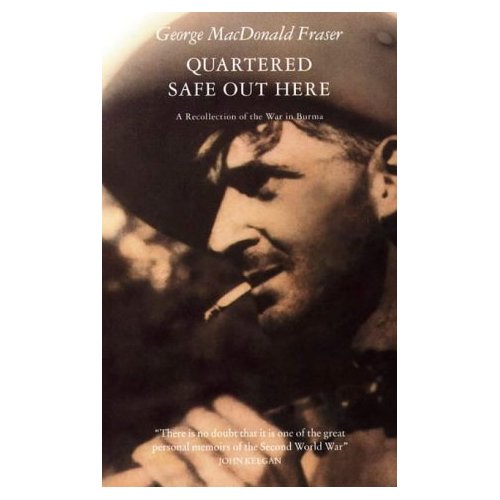
QUARTERED SAFE OUT HERE, George MacDonald Fraser, (originally published in 1994)


A memoir written about a young British soldier's experiences in the Burma campaign during World War II. Skillfully written, it reads like a novel. And no wonder. It was written by the author of the hugely popular and critically acclaimed "Flashman" series of historical novels.


 THE FORGOTTEN SOLDIER, Guy Sajer, (originally published in 1965)

 Forgotten Soldier.jpg

The author makes the claim that The Forgotten Soldier is an account of his experiences as a teenager in the German army fighting on the Eastern front against Soviet Russia.  Some experts believe that it is an authentic memoir while others dispute that claim and insist that it is a novel. Whether memoir or novel, it is a powerful book.


Once Upon a Distant War: David Halberstam, Neil Sheehan, Peter Arnett--Young War Correspondents and Their Early Vietnam Battles, William Prochnau (originally published in 1996)

 Front Cover

The following individuals should read this book: 1) anyone interested in the Vietnam War; 2) anyone interested in journalism; 3) anyone not interested in the Vietnam War; 4) anyone not interested in journalism; 4) everyone.


Sunday, July 19, 2015

QUICK HITS

The following are some quick looks at a few books set in the American West  that I think deserve a 5 out of 5 rating:

THE COURT MARTIAL OF GEORGE ARMSTRONG CUSTER, Douglas C. Jones (originally published in 1976)


Douglas C. Jones has long been one of my favorite writers.  This was the first of many fine novels to be written by the native Arkansan and retired military officer.  In 1976, it was the winner of the Western Writers of America's prestigious Spur Award for best Western novel.

Publisher's blurb: Suppose that George Armstrong Custer did not die at the Battle of Little Bighorn. Suppose that, instead, he was found close to death at the scene of the defeat and was brought to trial for his actions. With a masterful blend of fact and fiction, The Court-Martial of George Armstrong Custer tells us what might have happened at that trial as it brings to life the most exciting period in the history of the American West.


SEASON OF YELLOW LEAF, Douglas C. Jones (originally published in 1983)


Based on the life of Cynthia Ann Parker, this is the story of ten-year-old Chosen who was taken captive by the Comanches and whose son Quanah later became the last war chief of that tribe.


GONE THE DREAMS AND DANCING, Douglas C. Jones  (originally published in 1984)


Quanah Parker

This is a sequel to Season of Yellow Leaf.  Based on the life of Quanah Parker, it is a fictional account of his efforts to save his people.  In 1984, it was the recipient of the Western Writers of America's Spur Award for best Western historical novel. 


FOOL'S CROW, James Welch (originally published in 1986) 


Dee Brown says this about James Welch's Fool's Crow: "Remarkable for its beauty of language...May be the closest we will ever come in literature to an understanding of what life was like for a western Indian." That is high praise indeed and even more meaningful since it comes from the author of Bury My Heart at Wounded Knee and who is also one of the most respected of all historians of the American West.


THE LAST CROSSING, Guy Vanderhaeghe (originally published in 2002)


The Last Crossing is a big, sprawling epic Western novel. Some critics have compared it to the Western novels of Cormac McCarthy. I can't agree. It is true that it does share some similarities with McCarthy's novels, but it isn't nearly as dark.

I think a better comparison would be Larry McMurtry. Both writers have a better sense of humor than McCarthy (who seems to have none at all), and their writing, though often characterized by scenes of graphic violence, also have moments of humor which help lighten the mood.

The Last Crossing is as almost good as McMurtry's best and far superior to his worst. 


Wednesday, July 15, 2015

SILAS MARNER by George Eliot

Dear Ms Park,

I finally finished reading Silas Marner.  Yes, I know you assigned it during my sophomore year in high school, but I didn't finish it until this past February.  I know I passed the test you gave us on the story and I even made a passing grade on the paper that I wrote about the story.  But I have to confess that it was Jake D.'s Classic Illustrated Comics version of the story that allowed me to make those grades.  Poor Jake.  Even after reading the comic book  from cover to cover he still failed both assignments.

Since I'm confessing and apologizing I suppose I should add one more thing.  I'm sorry you caught me that day in class reading a paperback copy of Erskine Caldwell's God's Little Acre that I had tucked inside my lit book when I was supposed to have been reading about Silas.  Now there was a writer.  Erskine Caldwell, I mean.  He could tell a story and, unlike Silas Marner, things happened in his books.
 
I had just gotten to a really interesting scene in this one when you caught me, the one with Darlin' Jill and the albino.  I can still see your hand dart across my shoulder and snatch the book away.  And then with everybody in the class looking, and while you held the book between your thumb and forefinger like it was a dead mouse, you looked at me and said one word, "Trash." Boy, was my face red.  I never did know if you were talking about the book or me -- or both.

But in my defense, neither I nor any other fourteen-year old boy should have been required to read Silas Marner, unless, of course, the goal was to instill a hatred of reading.  I say this as someone who always loved to read from the time that he first learned to read.  Discounting comic books, poor old Jake, on the other hand,  despised reading and had never read an entire book in his whole life.  He might have been enticed to read about the Three Musketeers or Robin Hood or Huck Finn, but never Silas Marner.
 
One of the problems that I had at first with the story was the fact that you told us that the author's name wasn't really George Eliot.  I remember thinking that I didn't blame him for not using his real name.  I wouldn't have either.  But then you told us that George's real name was Mary Ann Evans!  Well, as far as I was concerned that made George a lot more interesting than Silas.

I also remember you telling us that Eliot/Evans' most famous quote was: "It is never too late to be what you might have been."  Even at age fourteen, I found that to be profound and inspiring, much more so than the few pages I read in Silas Marner.  But I recently discovered that the quote does not appear in anything that she wrote and that there is no evidence that she ever said it. I am no longer inspired, just disappointed.

But, as I say, I finally read the whole story.  Here's my review: "It was better than I expected."

By the way, if you read my copy of God's Little Acre, the one you never returned, I bet you found it to be better than you expected, too.

Your former student,
Anon.